


[An LSG Media podcast episode on the film came up this week which sent me back to the archive for this piece below I wrote a few years ago.]
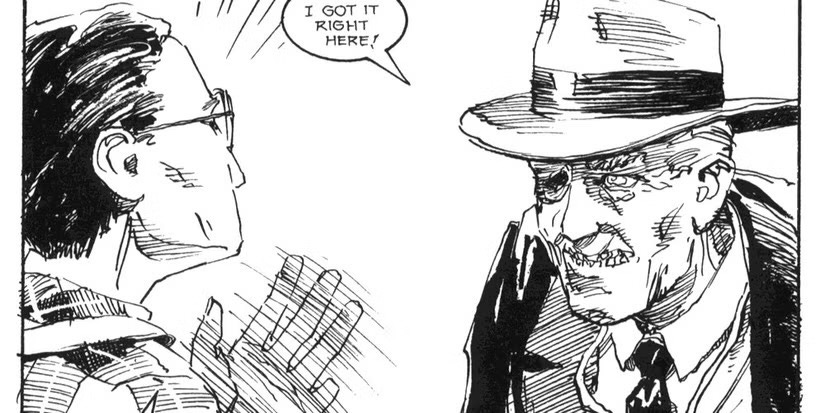
I watched A History of Violence again recently, and then did the thing I always do afterwards, which is disappear down the background for a couple of days, and somewhere in the middle of all that reading I noticed something a bit odd. For a film that has been picked over for twenty years, in anniversary retrospectives and best-of-the-century lists and long serious essays about the American appetite for justified brutality, the book it came from barely gets a look in. Cronenberg, yes. Mortensen, endlessly. Josh Olson's script, quite rightly. But the 286 page black and white graphic novel that supplied the title, the premise and more or less the entire first act tends to turn up, if it turns up at all, as a clause near the bottom of a paragraph.
Which is strange, because this was not the way it went for the other Paradox Press book. Road to Perdition reached cinemas three years earlier, and Sam Mendes came to it as a book, the graphic novel was reprinted to coincide with the film's release, Time ran a piece pointing readers back to the original, and Max Allan Collins was hired to write the novelisation of the screenplay adapted from his own comic. It sat in the same run of non-superhero comics adaptations as Ghost World and From Hell, and in all of those cases the source was part of the story being told about the film. Twenty-odd years later, most people who love Road to Perdition know it started life as a comic. Most people who love A History of Violence do not.
This is not a scandal, and I want to be clear about that up front, because the temptation with a piece like this is to work yourself into a lather on behalf of a creator who has not asked for it and does not need it. What it is, though, is a decent case study in how comics get remembered, or rather how they get remembered up until the moment something more expensive turns up wearing their clothes.
The book
A History of Violence was published in May 1997 by Paradox Press, an imprint of DC, 286 pages, black and white, written by John Wagner with art by Vince Locke, lettering by Bob Lappan and edited by Andy Helfer.
The premise is one of those ideas so clean you wonder why nobody had done it before. Tom McKenna runs a café in a small Michigan town, two armed robbers walk in, and Tom kills them both with an efficiency that nobody who knows him can quite square with the man they thought they knew. The town celebrates. The news cycle arrives. And then a one-eyed ageing hitman called John Torrino turns up from New York with a pendant round his neck containing a severed finger, and tells Tom that his name is actually Joey Muni, and that they have unfinished business going back twenty years. The horror of it is not the mob, it is the publicity. Tom has built a life that only works if nobody ever looks at him properly, and the thing that undoes him is being called a hero.
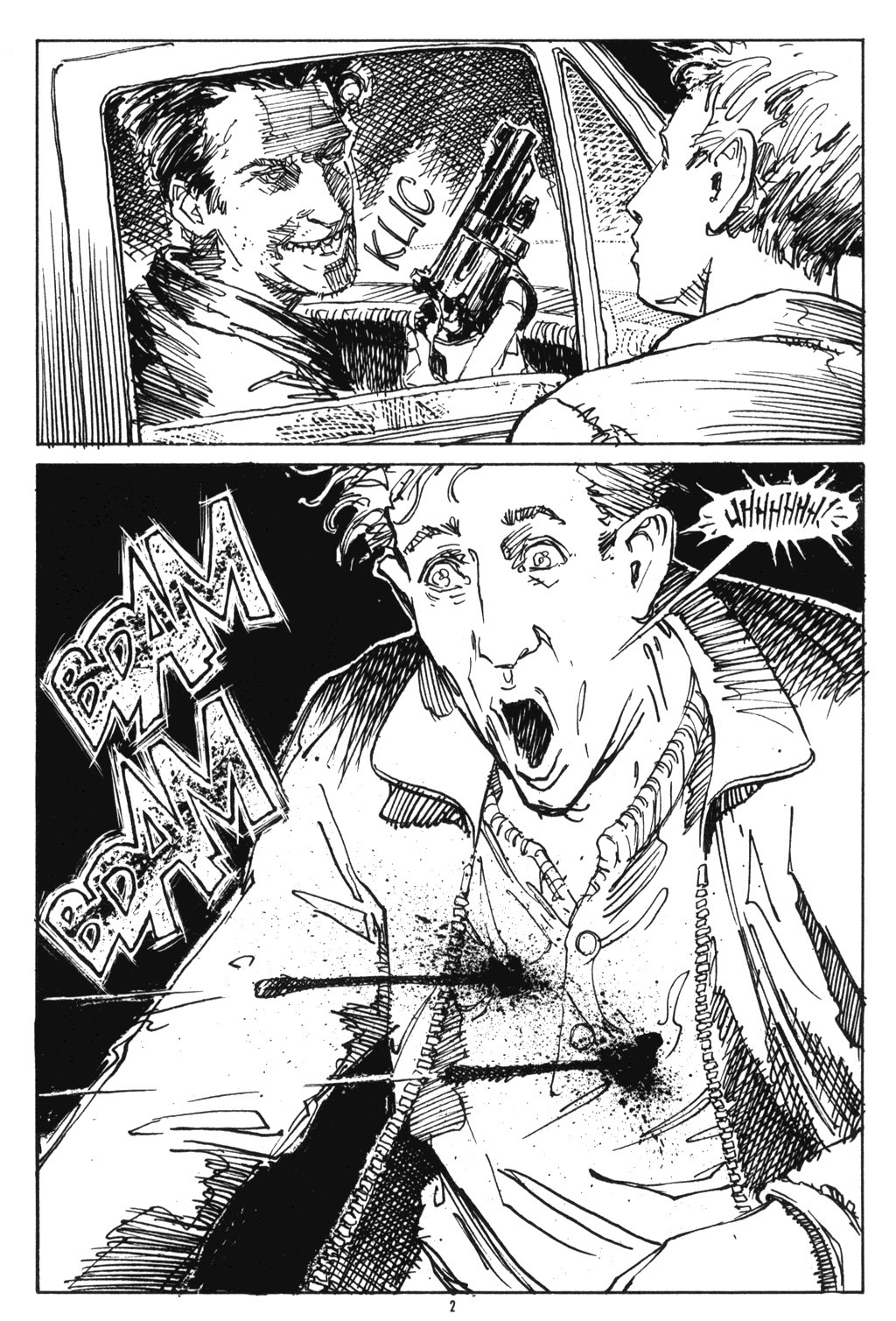
Locke's art is worth stopping on, because it is doing something the film could never do. Scratchy, cross-hatched, restless pen work that makes ordinary Michigan afternoons feel provisional, as though the world might come apart if you leaned on it. He was not a name at the time, known mainly for Deadworld at Arrow Comics and American Freak at Vertigo, and to comics readers of a certain vintage he is better known as the man who drew Cannibal Corpse's sleeves, which is a lovely bit of context for a book set in a diner.
Paradox itself deserves a paragraph, because it was one of those noble doomed publishing experiments that the industry throws up every decade or so and then quietly buries. Set up in 1993 out of the wreckage of Piranha Press, its whole reason to exist was graphic novels that were neither superheroes nor fantasy, the two things DC and Vertigo had already covered, aimed squarely at bookshops rather than the direct market. It never sold, and DC shut it down in 2001. Two books survive in the culture, and both of them survive because Hollywood turned up, which is the whole argument in miniature. An entire imprint's legacy, an editorial project with real ambition behind it, reduced to two films, only one of which is generally remembered as having been a comic at all.
The film
Here is where it gets interesting, and where the received version of events needs a bit of care.
Josh Olson wrote the screenplay, and he has never pretended it was a faithful adaptation. Asked by Variety in 2006 what he had changed, his answer was "Everything." He kept the first act, then went off and told a different story, cutting the flashback structure and making the lead far more ambiguous by introducing the wrong-man scenario, which he described in that same piece as turning it into something about identity and morality.
Cronenberg came to the script, not to the book. He said as much at San Diego Comic-Con in 2005 and in interviews around the release, telling Rebecca Murray that he had no attachment to the graphic novel and, in his words, "No investment in it." His investment was in Olson's script, which he and Olson had already developed some way down the road before anyone mentioned to him that a comic existed at all. Viggo Mortensen, incidentally, was not impressed by the early draft either, describing it years later to the Telegraph as senseless mayhem, and only signed on after meeting Cronenberg, who reworked it.
So we have a director who genuinely did not know, a screenwriter who genuinely did change nearly everything, and a book that nevertheless supplied the title, the premise, the entire first act and the moral engine of the thing.
What actually changed
The opening is close to a straight transposition. Diner, robbery, the killing performed with a competence that frightens everyone including the audience, the media swarm, the strangers arriving to say you are not who you claim to be, the son used as leverage, the family finishing the job. That is all Wagner, beat for beat.
What Olson altered was the meaning, and he altered it with one decision. In the book, Joey took part in a heist to raise money for his grandmother's heart operation, which makes him a fundamentally decent man who did an appalling thing under pressure and has been running from the consequences ever since. In the film, Joey Cusack was a mob enforcer, a killer by trade. That single change is what allows Cronenberg to make a film about violence sitting dormant inside ordinary people rather than a film about a debt falling due, and everything else follows from it, including William Hurt's character, who goes from being a childhood friend kept alive and tortured for twenty years to a crime boss brother, and including the endings, which could not be further apart. The book finishes in a warehouse with a chainsaw and a mercy killing. The film finishes at a silent dinner table with a plate being passed. Both work. Only one of them was ever going to get an Oscar nomination.
Were they right to distance themselves?
Mostly, yes, and this is where I part company with the version of this story that has Wagner as a wronged man.
Distancing yourself from a source is not the same as concealing it. Olson has consistently named the book while listing what he threw out of it, which is exactly what an honest adapter should do. Cronenberg's position is stranger, but he did not option the book, the producers did, and there is something more respectable about a director saying plainly that he had no relationship to a text he had not read than there would be in performing a reverence he did not feel. The failure sits upstream, in a production process where a film can shoot and wrap without anyone thinking to mention the source material to the person directing it.
The part that does not sit well is the shape of the publicity. Independent comics were carrying real cultural capital in 2005, and New Line was perfectly happy to put Cronenberg in front of a comics audience at San Diego, where he then explained that he had no attachment to comics whatsoever. That is a studio having it both ways, and it is worth noting that this reading is not mine originally, it is broadly the argument Mark Browning makes in David Cronenberg: Author or Filmmaker, which is where I would send anyone who wants it argued properly.
Wagner himself, and this matters, is not aggrieved. Speaking to the Shropshire Star in 2019, he said that once the rights were sold the production had no interest in his opinion, that Cronenberg did not know the film was based on a comic until the end of shooting, and that they had paid well up front, adding "Take the money and run, I don't mind doing that." He thought they did a decent job of it. His one real objection was the final act, and he said he understood why it was changed, since his ending was probably too violent for them. That is a working writer's assessment, delivered without self-pity, from a man who has watched his work adapted enough times to have calibrated his expectations.
Where the forgetting actually happens
Which brings me back to where I started, because the erasure is not Cronenberg's doing and it is not New Line's either.
The credit was given. It is on the film, "based on the graphic novel by John Wagner and Vince Locke." Olson's Academy nomination was in a category literally called Adapted Screenplay, which is about as institutional an acknowledgement as the source of a story can get. The book was nominated for the Prize for Scenario at Angoulême in 2006, although you will notice that came the year after the film, which tells you something about how attention travels.
The forgetting happens later, and it happens gradually, in the twentieth anniversary retrospectives and the best-of-the-century lists and the podcasts, where the film accumulates prestige and the book quietly falls off the bottom of the paragraph. A History of Violence is now sitting at number 33 on Rolling Stone's hundred best films of the century, it was the last major Hollywood release to come out on VHS, Criterion gave it a UHD edition in October 2025, and Lokesh Kanagaraj's Leo in 2023 was an explicit tribute to it. That is a film with a long and healthy afterlife. Meanwhile the book that started it has spent most of the last two decades out of print or hard to find, remembered mainly by people who came to it backwards.
This is what happens to comics in the wider culture. They are treated as raw material rather than as finished work, a quarry rather than a building, and once the film exists the film becomes the text and the comic becomes trivia. Nobody discusses No Country for Old Men without mentioning Cormac McCarthy. Nobody gets through a conversation about The Shining without Stephen King turning up, usually to complain. But a 286 page black and white graphic novel that supplied the title, the premise and the first twenty minutes can vanish entirely, and the omission goes unremarked because we have not yet agreed, collectively, that comics count as authorship in the same way.
And before anyone holds Road to Perdition up as the model, it is worth saying that the credit visible on the poster and the treatment handed out behind it are two different things. Collins has written openly about the DreamWorks licensing department cutting his novelisation to pieces, insisting that nothing appear that was not in the shooting script, right down to lines dropped in the edit, and about the distinct impression that nobody there much cared that he had invented the story in the first place. So the comparison is not that Collins was looked after and Wagner was not. It is narrower than that, and more about publicity than kindness. Perdition was sold to the public as an adaptation of a comic, and A History of Violence was sold as a Cronenberg film, and twenty years on you can still see the difference in what people remember.
The good news is that the book is still there, and it is still bleak and lean and much nastier than the film, and Locke's line-work still makes small-town America feel like it is about to fall through the floor. Go and find a copy. It has been waiting patiently, which is more than most of us manage.
Sources:
Wikipedia entries for A History of Violence (comics), A History of Violence (film) and Paradox Press;
John Wagner interview, Shropshire Star, 1 June 2019;
Josh Olson interview, Variety, 2 February 2006;
David Cronenberg interview with Rebecca Murray, About.com, 2005, quoted in Neil Young's Film Lounge;
Viggo Mortensen interview, Telegraph, 14 May 2014;
Mark Browning, David Cronenberg: Author or Filmmaker, Intellect Books, 2007;
Illustration Art Gallery on Vince Locke;
Britannica on Paradox Press;
Wikipedia entries for Road to Perdition (film) and Road to Perdition (comics);
“The Original Road to Perdition", Time, July 2002;
Max Allan Collins, "The Long Road to Perdition", Brash Books, 2016.