

Born in the Gutter, Built for Everyone: How Silicon Valley Annexed a Culture It Never Understood
…and how the medium that gave a voice to the voiceless got sold to the people who were never lost for words.

The internet has been over and over the history of comics with a version that starts with Superman in 1938 and moves in a clean arc through the Silver Age and the British Invasion and Watchmen and Maus until it arrives, triumphant and validated, at the multiplex blah blah. It is a story about a medium finding its audience, earning its respectability, graduating from the newsstand to the museum.
It is, in other words, the story that the people who now want to own superheroes prefer to tell, because it ends with the medium as a commercially viable intellectual property machine with a decades-long runway of source material.
It is not, however, the actual story.
The actual story is considerably messier, more uncomfortable, and in the context of what is currently happening to the industry, considerably more important.
Comics were not created by people with platforms or institutional backing or cultural permission, they were assembled (often in genuine poverty and frequently under active discrimination) by people the respectable world had decided were not worth listening to. Understanding that origin is not a sentimental exercise, it is the only way to understand what is being lost, and who is taking it.
You need to begin in New York in the 1930s, in the tenement neighbourhoods where Jewish immigrant families had settled after fleeing persecution in Europe.
The publishing industry, the advertising industry, the respectable media of that era were largely closed to them, and what was available was the gutter end of the print trade: cheap paper, lurid covers, penny-a-page rates, and absolutely zero cultural prestige. Into that space walked men like Jack Kirby, born Jacob Kurtzberg on the Lower East Side to Austrian immigrants who had left because staying was dangerous, and Joe Simon, and Jerry Siegel and Joe Shuster, two boys in Cleveland who created Superman in a rented room and sold the rights for $130 because the alternative was not eating. These were not people making a calculated creative investment, they were outsiders using the cheapest available medium because it was the only one that would have them, and they poured into it everything they knew about being feared, excluded, and underestimated. Captain America punching Hitler on the cover of his debut issue in 1941 was not a piece of cynical marketing, it was drawn by a Jewish man who understood exactly what Hitler was doing, a year before America officially entered the war, at a time when that view was not yet the consensus.
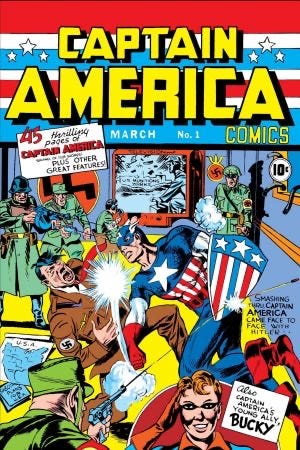
Captain America #1, March 01, 1941
Will Eisner built urban theatre from the texture of Jewish New York, treating the city’s street corners and fire escapes and immigrant interiors as the emotional architecture of a medium that everyone else was still using for fistfights and space opera. When he later insisted on the term graphic novel, he was not making a branding decision, he was arguing, with considerable urgency, that this form deserved to be taken seriously, that the people who made it and the people who read it deserved to be taken seriously, and that the gatekeepers of literary culture who had spent decades dismissing comics as children’s entertainment were wrong in ways that mattered.
(Eisner did not invent the phrase "graphic novel," but his 1978 book A Contract with God popularised it. To avoid the juvenile stigma of "comic books," he also championed the term "sequential art" to describe his narrative medium. The term is widely attributed to American comic book fan and historian Richard Kyle in 1964.)
Across the Atlantic the coordinates were different but the principle was identical. British comics, particularly the weeklies that shaped the reading lives of multiple generations of working-class children, were produced on rough newsprint for readers who were not the target audience of anything else the culture was producing. Pat Mills, writing Charley’s War for Eagle in the early 1980s, was not delivering a literary statement about the First World War for a broadsheet readership. He was writing working-class history and smuggling it into a boys’ weekly, describing the slaughter at the Somme through the experience of an underage soldier who had lied about his age to enlist, because that was the story Mills’s own family had lived and that the official version of British history had spent decades refusing to tell. The strip is now cited by historians as one of the most accurate portrayals of trench warfare in British media. It ran in a comic that cost a few pence and was read on the back seats of school buses by children who had no idea they were absorbing an act of radical historical recovery.
2000AD carried a similar energy, just pointed at a different set of targets. The strip that produced Judge Dredd, Rogue Trooper, Sláine and a dozen other strips that warped the imaginations of everyone who grew up with them was built on a foundational distrust of authority, a relentless willingness to make institutions look corrupt and stupid, and a tonal range that moved from deadpan satire to existential horror within a single issue. It was, in retrospect, the perfect reading material for children growing up in Thatcher’s Britain who could feel, even if they couldn’t yet articulate it, that the official optimism of the era was a fiction being maintained by people who would not be paying the price for it. The creators who built 2000AD, the writers and artists who collectively invented its visual and narrative DNA, were not doing this from positions of comfort or security. They were grinding out pages against savage deadlines for modest page rates, working across multiple strips simultaneously, building something they were making up as they went, and the result was one of the most formally adventurous and thematically rich comics traditions in the world.
The readers who built fandom around all of this were similarly drawn from the parts of the culture that the mainstream had decided were not worth serving. Queer teenagers who found in certain characters a coded language for experiences they could not yet name in the rooms they actually inhabited. The X-Men’s entire premise, a group of people feared and persecuted for something they were born with, who nevertheless commit their lives to protecting a world that would rather see them destroyed, was not subtle, and it was not accidental, and for LGBTQ+ readers it arrived with a force that polite literary fiction, even the well-intentioned kind, rarely managed to match. The metaphor worked because it was specific and because it was drawn with conviction and because it asked the reader to sit with the full weight of what exclusion feels like rather than just gesturing at it from a comfortable distance.
Black readers came to comics and found, scattered among decades of embarrassing representations and outright caricature, characters who carried something real about the experience of living in a world structured against you. When Black Panther arrived in 1966, created by Kirby and Lee, it was a genuine rupture: a Black king, a genius, the ruler of the most technologically advanced nation on Earth, written at a moment when American society was being forced at the cost of considerable blood to acknowledge that Black citizens deserved basic civil rights. The character’s cultural resonance was never separate from that context and never could be. Women, who were for decades rendered invisible or decorative in mainstream comics, built their own spaces outside the gravitational pull of the Big Two: feminist zines, queer anthologies, small-press tables at conventions where the work being sold was formally adventurous and emotionally honest in ways the corporate product rarely allowed itself to be. Those were not side quests or peripheral concerns. They were, often, the actual cutting edge of what the medium was capable of.
The underground comix movement of the late 1960s and early 1970s made all of this explicit in terms that nobody could mistake for anything other than what it was. Robert Crumb, Spain Rodriguez, Trina Robbins and the others who built that scene were producing work that was deliberately, provocatively adult, sexually explicit, politically incendiary, formally adventurous, and structurally committed to the idea that the cheap disposability of the medium was a feature rather than a flaw, that it allowed them to say things in a stapled pamphlet sold from a record shop that no respectable publisher would touch. They were right, and the work they made remains, decades later, an extraordinarily honest record of what it felt like to be alive and politically conscious and alienated from official culture in that particular moment.
The point of all this history is not nostalgia, though the work repays attention on its own terms. The point is that comics arrived at whatever moral authority they now possess through a specific and traceable process. They were made by people who needed them, for people who needed them, and that necessity was not decorative. It produced a form with an unusual capacity for emotional honesty, for speaking to outsider experience with specificity and force, for holding up a mirror to power without first asking power’s permission. The medium’s ability to do all of that was not the result of a deliberate artistic programme. It was the natural consequence of who was making it and why.
Which brings us to the present, and to the precise nature of what is currently being done to this tradition.
Over the past several years, a cluster of technology companies, backed by the kind of venture capital funding that compresses decade-long industry transformations into eighteen-month product cycles, have built and released a set of tools capable of generating comic art, comic scripts, and complete comic narratives from text prompts, at industrial scale, in seconds. The companies involved, Stability AI, Midjourney, various iterations of image generation built into larger platforms, along with the growing constellation of comics-specific startups including Dashtoon, Shortbread, LlamaGen and others, present themselves in the language of democratisation. They are, they claim, making comics creation accessible to people who lack the technical skills to draw or the financial resources to hire artists. They are opening up the form. They are expanding who gets to tell stories.
It is worth spending some time with that claim, because it is the claim that has the most rhetorical purchase and deserves the most careful scrutiny.
The tools these companies have built were not trained on publicly available, freely licensed creative work. They were trained on the accumulated creative output of generations of working artists, scraped from portfolio sites, from DeviantArt, from archived comics, from the digitised collections of decades of human labour, without consent, without compensation, and without disclosure. The legal arguments around this practice are unresolved and genuinely complex, but the ethical architecture is not complicated at all. Jack Kirby’s visual vocabulary, the crackling energy of his machinery and the cosmic scale of his compositions, lives inside these models. Dave Gibbons’ panel construction from Watchmen is in there. The work of Amy Reeder, who has described losing a direct commission because the client used a model trained on her work to generate what they needed instead of hiring her, is in there. Every artist whose style has been indexed, ingested and made available as a prompt option, without being asked, without being credited, without being paid, is in there.
This is not, to be clear, the same as artistic influence. The history of comics, like the history of any visual art form, is a history of influence: artists learning from those who came before, absorbing visual languages and reinventing them, building on traditions they inherited. That process is how culture develops and how individual voices emerge from shared history. It is fundamentally different from training a statistical model on millions of images and then selling access to the resulting output as a content generation service. Influence involves a human being, with their own experience and perspective and set of choices, encountering other work and making something new from the encounter. What these models do is extract pattern from data and reproduce it without understanding, without history, without the specific human context that made the original work meaningful. The output looks like comics. It does not know what comics are.
The people most enthusiastically using these tools to flood platforms with generated content are not, in the main, the people for whom comics were built. They are not the queer teenager who needed Northstar to exist before they could find language for their own experience. They are not the working-class British kid who found something true and unpatronising in a 2000AD strip. They are not the Black reader who recognised themselves in a character the mainstream had spent decades ignoring, or the woman building her own space in a medium that treated her as an afterthought. They are, disproportionately, people with disposable income and programming skills, people who grew up in the digital content economy and understand creative work primarily as a production problem to be optimised, people for whom the idea that making something requires skill and time and stakes and genuine human investment is an inefficiency rather than the actual point. The technology press has a word for this demographic, though it rarely applies it critically: tech bros. People who want the product without the grind, the aesthetic without the history, the content without the cost.
The startup pitch decks for companies like Dashtoon, which promises to transform any story into a global comic sensation in minutes, or Shortbread, which describes itself as the Netflix of comics and boasts the ability to generate episodes ten times faster than traditional workflows, are a revealing document. They are addressed to investors, not readers. They measure success in throughput and market capture, not in the quality of what is being produced or the wellbeing of the people whose work funded the training data. They describe the comics industry as a market to be disrupted rather than a culture to be participated in, which is an important distinction, because it tells you exactly what relationship these companies have to the tradition they are cannibalising. The comics industry, in their framing, is a problem: slow, expensive, dependent on skilled human labour, resistant to the kind of venture-capital-backed scale that turns modest cultural products into billion-dollar intellectual property pipelines. The solution, in their framing, is to remove the humans from the process wherever possible, retrain the market to accept machine-generated output as equivalent to hand-made work, and capture the margin that currently goes to artists, writers, colourists and letterers.
This is not, to be clear, an ideological project. It does not emerge from any political position or cultural agenda. It is, far more simply and far more depressingly, an economic one. The comics industry has always been structurally exploitative of its creators, as anyone familiar with the work-for-hire contracts that stripped Jack Kirby and Joe Shuster and Bill Finger of ownership over the characters they created will know, and the arrival of generative Ai represents not a rupture with that history but its logical extension. The people at the bottom of the creative pipeline, the colourists and letterers whose labour is structural but invisible, the mid-list pencillers who held the industry together across decades without ever becoming famous, the writers working on assignment for modest page rates with no royalties, were always the most economically vulnerable. They are the ones who have already begun to lose work, not in some hypothetical future but now, as publishers discover that generated backgrounds are cheaper than commissioned ones, that generated covers attract enough clicks to justify the saving, that the audience, presented with polished synthetic output without context, often cannot tell the difference.
When Marvel used an Ai-generated title sequence in the Disney+ series Secret Invasion, the detonation of criticism that followed was not primarily about quality. It was about signal. The message that sequence sent to every working creative in the industry was unambiguous: we can do this without you, and we will do it without you, and when we do it, we will not tell you, and we will not apologise. The fact that the sequence was widely regarded as aesthetically inferior to what a commissioned artist would have produced was almost beside the point. The point was the intent, and the intent was legible.
What is being taken from comics in this moment is not just jobs, though it is certainly that. It is the specific transmission mechanism through which the form reproduces itself: the apprenticeship, the mentorship, the long years of grinding work through which a person develops not just technical skill but a way of seeing, a point of view, a voice. The mid-list artist whose consistent work across decades of unremarkable issues was, quietly, how the next generation of artists learned what the job actually involved, is already becoming economically unviable. The colourist who understood precisely how light behaves across a page and what emotional register a particular palette produces is finding their expertise undermined by tools that approximate those effects without understanding them. The conditions under which comics culture reproduced itself are being systematically dismantled, not because anyone has decided that comics matter less, but because the companies doing the dismantling are not thinking about comics at all. They are thinking about content markets, about data, about scale, about the gap between what skilled human labour currently costs and what automated generation costs.
The form was built by people who had been excluded from the rooms where respectable culture was made. LGBTQ+ readers, Black readers, working-class readers, immigrants and outsiders of every description found in it something the mainstream refused to offer: stories that saw them, characters who felt like them, a medium cheap enough and strange enough to let marginalised voices speak without first being approved by a committee. None of that happened because comics were progressive in the contemporary political sense of the word. It happened because the people who built the form had skin in the game. They were drawing from experience that was real and specific and sometimes frightening, and readers recognised that, and trusted it, and built their emotional lives around it in ways that still show up in conversations at conventions and secondhand stalls decades later.
What is being generated by models trained on that tradition, operated by people who have no relationship to the conditions that produced it, is something categorically different. It looks like comics. The panel rhythms are there, the speech balloons, the visual grammar assembled from decades of scraped and ingested human work. What is absent is everything that made the grammar worth having in the first place: the stakes, the specific human consciousness trying to tell a specific truth about a specific experience, the grind and the failure and the revision and the thing that finally works on the fourth attempt because the person doing it cared enough to keep trying. The machine does not care. It cannot care. It produces outputs that satisfy the pattern requirements of the training data without having any relationship to what those patterns were originally expressing.
To hand those tools to people who never needed an escape route, who never sat in a school bus or a doctor’s waiting room or a difficult childhood bedroom and felt a comic open a door that everything else kept closed, and to call that democratisation, is one of the more audacious acts of rhetorical sleight of hand that the technology industry has managed in a decade not short of competitors. The people the form was built for, the ones whose need shaped it into something worth having, are not the beneficiaries of this development. They are its casualties. And the people benefiting from it are, in the main, precisely the demographic that comics spent most of its history speaking against: those with institutional power, economic comfort, and no particular interest in what the medium cost to build or who paid that cost.
That is the hijacking. Not a conspiracy, not a coordinated attack, not even a deliberate cultural project. Just capital moving, as it always moves, toward the cheapest available means of production, indifferent to what gets destroyed in the process, and cheerfully describing the destruction as progress.
Comics have always survived by being underestimated, and so question my new book asks, with some urgency, is whether survival is still enough, or whether what is actually at stake this time is the conditions that made the form worth surviving for in the first place. What I tried to do attempt to find out, told through the people who built it, the people who are fighting for it, and the machines that have decided it belongs to them.
Born to Extinction is out now, published independently and all proceeds are donated to grassroots creative groups battling to keep their craft alive.