

He Drew the Joke in 1923. It Took a Century to Land.
In 1923, a cartoonist drew his own redundancy as satire. Then 2023 arrived.

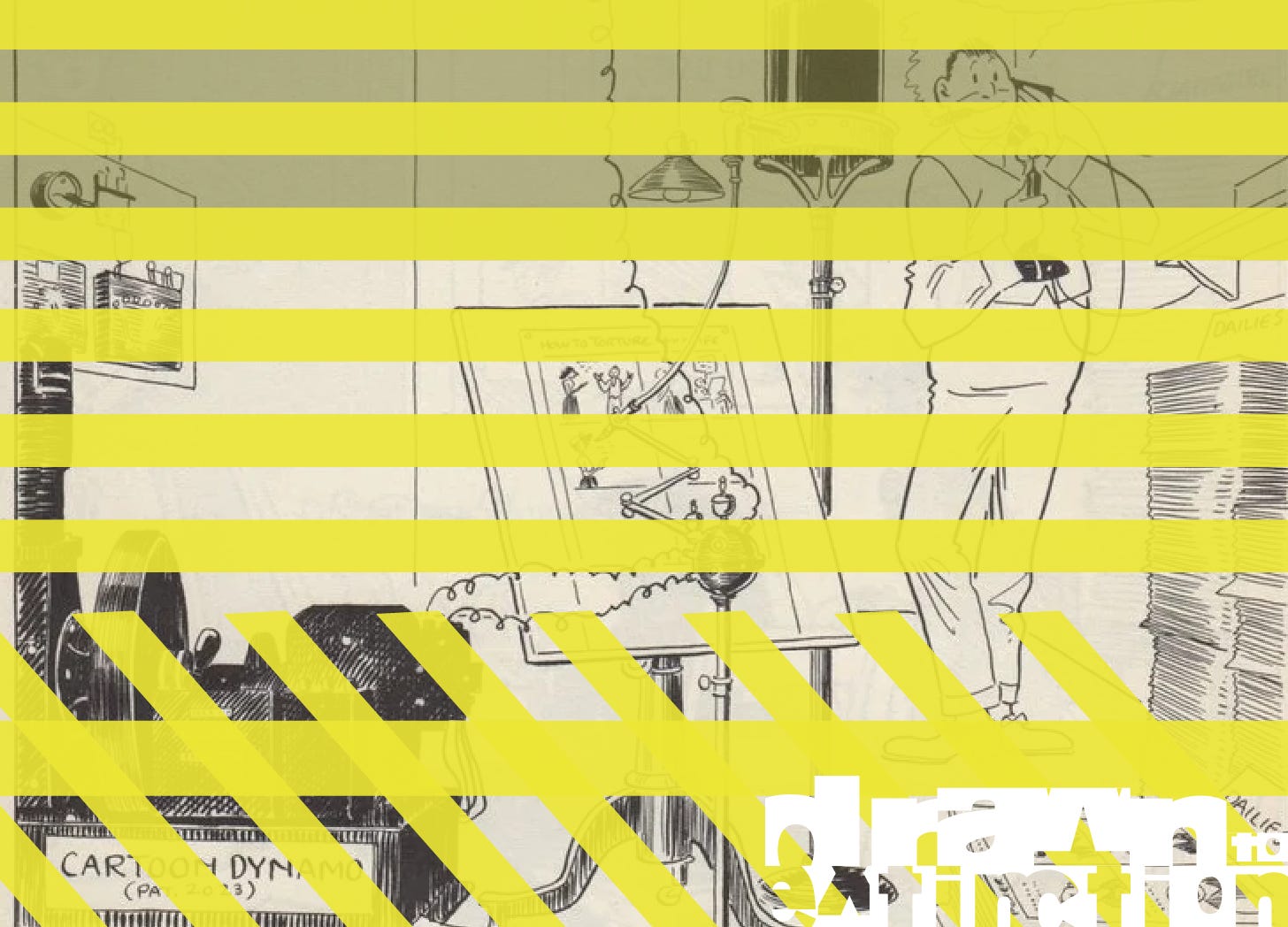
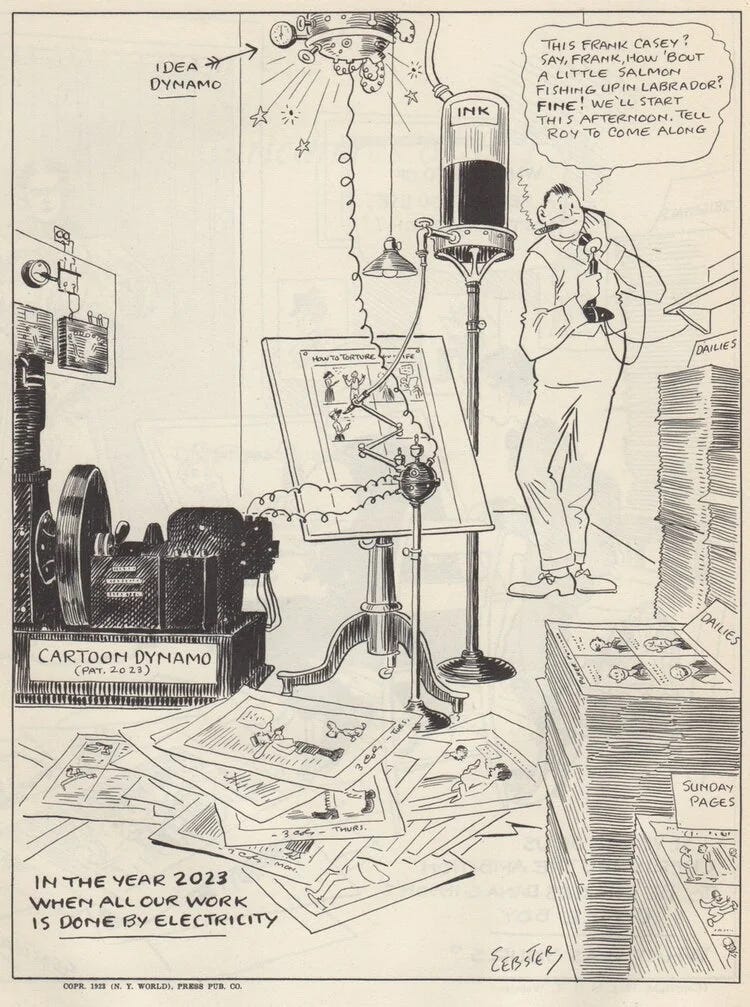
In 1923, a cartoonist named H.T. Webster sat down at a drawing table somewhere in New York and drew a picture of a machine that would put him out of a job. He called it the Cartoon Dynamo (Pat. 2023), gave it an Idea Dynamo for a brain, a tank of ink for blood, and a drawing arm that could produce daily strips and Sunday pages without complaint, without coffee, without the particular human inconvenience of having somewhere more interesting to be. The man in the cartoon stands to one side, telephone to his ear, already making plans for a salmon fishing trip with Frank, while the machine does what he used to do.
At the bottom of the frame, Webster wrote the caption: In the year 2023, when all our work is done by electricity.
He drew it as a joke for the New York World, one of the great American newspapers of the era, where readers would have found it funny in the way that absurdist futures always feel funny from the safe distance of a hundred years. Of course nobody was going to build a machine that drew cartoons. The very idea was ridiculous. A machine couldn’t have ideas. It couldn’t have instincts. It couldn’t find the thing that was quietly funny about a suburban marriage, or a put-upon office worker, or the particular humiliation of a man outwitted by his own dog. Webster knew that better than anyone. He had built a career on exactly those instincts, winning a Pulitzer Prize and syndicating his work across the country, most famously through a recurring character called the Timid Soul, a mild, bespectacled everyman crushed gently but repeatedly by the indignities of modern life.
The Timid Soul would have understood what happened next.
Because in 2023, the actual year in Webster’s joke, tools like Midjourney and Stable Diffusion arrived in full public force. Anyone with a keyboard could now type a description and receive an image in seconds, rendered in any style you cared to name, including the styles of living artists who had spent decades developing them. The Cartoon Dynamo was no longer a punchline. It was a product. It had a freemium tier.
Webster saw it coming, not as prophecy, because he didn’t see it coming at all, that’s rather the point. He was satirising the anxieties of industrial modernity, the creeping fear in the 1920s that machines were coming for every category of human labour, including the creative ones. The cartoon is funny because the anxiety is real, and the relief is that surely, surely, the artists were safe. A machine could replace a riveter. A machine could replace a telephone operator. But a cartoonist? The one whose job is to notice what’s quietly absurd about being alive and translate it into six panels? No. That required something the machine couldn’t be given.
And then it was given it.
Or at least, something that looks enough like it to have disrupted an industry. Whether generative Ai actually creates, whether it has anything resembling imagination rather than an extraordinarily sophisticated pattern-matching engine, is a conversation worth having at length. What isn’t in dispute is the effect. Illustrators, comic artists, animators and cartoonists are watching their commissions dry up, their styles scraped and replicated without consent, their years of accumulated craft treated as training data for systems that will undercut them on price to clients who can no longer tell the difference, or have decided they no longer need to.
Webster drew the joke, and the joke took a hundred years to land, and now the cartoonist in the frame isn’t standing to one side making fishing plans. He’s standing in an unemployment queue, holding a portfolio that nobody is asking to see.
There’s something else in the cartoon that snagged me the moment I first saw it. Look at the man on the telephone. He’s cheerful. Relaxed. Completely unbothered by the machine drawing away beside him. In his version of 2023, the Cartoon Dynamo is a convenience, something that frees him up for the good parts of life, the salmon fishing, the lunch with Frank, the leisure that automation was always supposed to deliver. He’s not worried, because in 1923, the story of automation was still a story about liberation. Machines would do the drudgery. Humans would flourish.
We got a rather different version.
What we got was automation that came for the interesting work first, because interesting work turned out to be the most legible to a machine trained on culture. The drudgery, the form-filling, the spreadsheet maintenance, still requires human oversight. The art, the writing, the illustration, the music: that’s the stuff the systems got good at generating something resembling, quickly enough to flood the market.
Webster’s cartoon, for all its warmth and wit, is a document of misplaced confidence. The confidence that creative labour was the last safe harbour. The confidence that a machine couldn’t have the thing that made the work worth making. That confidence was entirely reasonable in 1923. It’s a little harder to maintain now.
I’ve spent the last two years talking to comic book writers, artists and industry figures about exactly this, about what it means when the thing you’ve dedicated your working life to mastering becomes something a machine can approximate in thirty seconds, and what, if anything, can be done about it. The conversations were sometimes angry, sometimes grieving, occasionally darkly funny in ways Webster would probably have appreciated. What they were never was simple.
Because the story isn’t simply that the machines have won, or that human creativity is finished, or that we should all update our CVs for roles in Ai prompt engineering. The story is more interesting and more difficult than that. It’s about what we decide to value. About who benefits when creative labour is automated and who pays the price. About whether the speed and scale of generative tools actually enriches culture or whether it floods it with something that looks like culture, replicates its surface and patterns, but carries none of the weight that made it matter in the first place.
The machine doesn’t dream. It replicates. And in that difference is the whole reason this conversation is worth having.
Webster knew the joke. He drew it in ink, with his own hand, at a table in New York, in 1923, and the punchline arrived a century later in a form he couldn’t have predicted and almost certainly wouldn’t have found funny. The Timid Soul, I think, would have recognised the feeling. That particular modern sensation of watching something you were absolutely certain couldn’t happen, happen, with the smooth inevitability of a thing that was always going to happen, and nobody being quite sure what to do next.
These questions are at the heart of Drawn to Extinction: Comics, Craft, and the Battle for Originality in the Age of Ai, my new book built on two years of conversations with some of the most important voices in comics, from Dan Cornwell and John Wagner to Ram V, Hannah Berry and copyright specialist Jonathan Bailey. If this landed for you, the book is where the argument goes deeper.