

Road to Perdition: Blood, Legacy and the Long Shadow of a Perfect Adaptation
The Comic Nobody Hyped, the Film Nobody Expected, and Why Both Deserve to Be Considered Classics

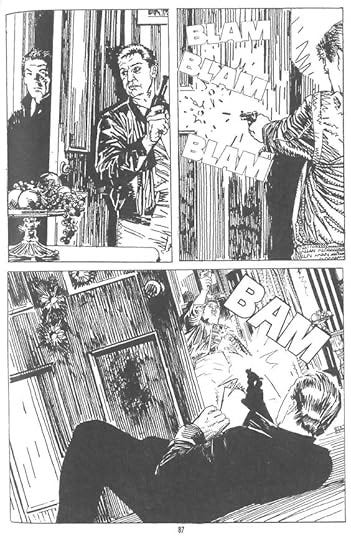
Max Allan Collins did not set out to write a landmark, I assume he set out to write a crime comic rooted in real history, drawn by an artist whose instincts were closer to European naturalism than American superhero gloss, published by a DC imprint that was quietly doing some of the most interesting work of the 1990s while the rest of the industry was arguing about foil covers. That Road to Perdition became something genuinely significant (as a graphic novel, as a piece of cultural furniture, and eventually as the basis for one of the finest comic book films ever made) says something about what happens when craft and intention align without the pressure of expectation.
The book arrived in 1998, and Collins had spent decades working in crime fiction, both prose and comics, and brought a novelist’s understanding of structure and moral weight to the material. His source was not invented, John Looney was a real figure, a genuinely dangerous and eccentric mob boss who ran Rock Island, Illinois with a combination of violence and a local newspaper he used as a blackmail instrument. Collins grounds his fictional O’Sullivan family inside that real geography and that real criminal ecosystem, which gives the story a texture that pure invention rarely achieves. You feel the period not as costume but as condition, the Depression not as backdrop but as pressure on every choice every character makes.
Richard Piers Rayner’s artwork is the other half of why the book works as well as it does, and it deserves more critical attention than it typically receives. Rayner is a British artist whose style sits somewhere between the scratchy expressionism of early Dave McKean and the grounded realism of European crime comics, and he is entirely uninterested in the kind of kinetic, muscle-heavy visual language that dominated American comics in the Image era. His panels are composed rather than pumped, atmospheric rather than explosive. The winter landscapes (and Road to Perdition is fundamentally a winter book, cold and grey and stripped of warmth) are rendered with a stillness that makes the violence, when it comes, feel genuinely shocking rather than choreographed. This is sequential art that understands silence. The gutters between panels do real work. What is left out is as considered as what is shown.
The story Collins builds inside that visual framework is deceptively classical. Michael O’Sullivan is an enforcer, a man who has built a wall between what he does professionally and who he is at home, and the narrative begins at the moment that wall collapses. His son Michael Jr. witnesses a killing. The Looney organisation decides the family cannot be trusted to stay quiet. O’Sullivan comes home to find his wife and younger son dead, and what follows is a road movie in panels, a father and his surviving boy moving across a hostile American landscape, the father pursuing vengeance and the son absorbing, quietly and irrevocably, the world his father inhabits.
Collins has acknowledged the debt to Lone Wolf and Cub, Kazuo Koike and Goseki Kojima’s extraordinary manga about a samurai and his infant son, and the influence runs deep, not just in the structural parallel of the violent father and the watchful child on a road that ends in blood, but in the emotional register, that particular tenderness between a man defined by killing and the boy who loves him anyway. What Collins adds is the American specificity, the Catholic guilt, the Irish immigrant community’s complicated relationship with loyalty and violence, and a moral framework that is less about honour codes than about the impossibility of keeping the worst of yourself away from the people you love most.
Commercially, the book performed solidly rather than explosively. Paradox Press was never a mass-market imprint, and Road to Perdition found its audience gradually, through word of mouth and critical respect rather than through the kind of event-marketing that drove mainstream sales. Collins extended the story through several sequels (On the Road to Perdition, Return to Perdition and others) with mixed results. The first book’s power comes partly from its self-contained weight, from the sense of an ending that doubles as a beginning for the son, and the sequels inevitably pull against that completeness. They are not without merit, but they are the work of a writer returning to a world rather than discovering it, and the difference is audible.
What transformed the book’s cultural profile entirely was Sam Mendes’s 2002 film adaptation, and this is where Road to Perdition deserves a more serious critical position than it is usually granted in conversations about comic book cinema.
The film arrived in a particular moment. X-Men had come out in 2000, Spider-Man in 2002, and the superhero adaptation machine was beginning to find its commercial footing. Against that context, Road to Perdition was an anomaly. A studio film based on a graphic novel that had nothing to do with capes or mythology, that was interested in grief and moral inheritance and the Depression, directed by a man who had just made American Beauty and brought the same willingness to let a frame breathe, to trust mood over momentum.
Tom Hanks was a bold and largely vindicated choice for O’Sullivan. The risk was obvious because Hanks carried so much goodwill from the audience, such a deep association with decency, that putting him in the role of a professional killer required the film to work hard to establish moral complexity without losing the audience’s capacity to follow him. What the casting actually achieves is something subtler: it uses that goodwill as a dramatic instrument, because O’Sullivan is genuinely decent within the terms of his world, a man whose violence is transactional rather than sadistic, whose love for his son is the most real thing about him. Hanks brings a stillness to the role that suits both the character and Mendes’s pacing.
Paul Newman’s John Rooney is quietly one of the great late-career performances in American cinema. Rooney knows exactly what he is. He has no illusions about the life he has built or the methods that sustain it, and Newman plays him with a kind of weary authority that is more unsettling than any conventional villain register. The scene where Rooney and O’Sullivan face each other across a rain-soaked street, both knowing what has to happen, is as good as anything in the film’s genre — measured, inevitable, genuinely sad.
Conrad Hall’s cinematography won the Academy Award and the recognition was deserved, not merely as technical achievement but as a demonstration of what the visual language of comics adaptation can aspire to. Hall and Mendes understood that Rayner’s panels were already cinematic in their composition, already thinking about light and shadow as emotional instruments rather than merely descriptive ones, and the film honours that rather than overriding it. The amber-and-grey palette, the rain that falls in almost every exterior scene, the faces half-lost in darkness, these choices are in genuine conversation with the source material rather than simply illustrating it.
Thomas Newman’s score deserves its own mention in any serious accounting of what makes the film work. This is not music that accompanies emotion so much as music that locates it, a spare and melancholic piano motif that runs beneath the film like an undercurrent, carrying the weight of inevitability without tipping into melodrama. Newman understood instinctively that the material needed space rather than punctuation, that swelling strings would have broken the spell that Mendes and Hall were so carefully weaving. Where lesser scores announce feeling, Newman’s holds back, sustaining notes that fade rather than resolve, compositions built around the held moment rather than the dramatic release. It is music that knows something cannot be fixed, only carried forward, which is precisely the emotional truth the film is trying to tell.
What makes it particularly remarkable in the context of adaptation is how closely it mirrors what Rayner was doing on the page. Sequential art works in silence as much as in image — the gutter between panels, that white space where the reader’s imagination completes the action, is where much of the emotional weight of a great comic actually lives. Newman found the sonic equivalent of that gutter, the pause, the breath, the note left hanging in a cold room. The result is a score that feels less composed than discovered, as though it was always there inside the material waiting for someone with the patience and the restraint to draw it out.
Where the film departs most significantly from the book is in tone and texture. Collins writes in a genre tradition that is comfortable with pulp energy, with the pleasures of crime fiction as crime fiction, and Mendes smooths that into something more uniformly elegiac. The film is slower and sadder and more self-consciously literary than the book, which is not a failure but a different conversation with the same material. Some of the book’s moral complexity gets simplified in translation, the sequels Collins wrote suggest a richer ecosystem of consequence than the film has time to explore, but what the film prioritises, it handles with exceptional care.
The comparison to Watchmen, Sin City and 300 is worth making seriously rather than as a marketing gesture. All four films share a commitment to treating their source material as visual literature rather than as story content to be extracted and repackaged. Zack Snyder’s approach to both 300 and Watchmen is formally faithful to a degree that divides critics — Frank Miller and Dave Gibbons’ panel compositions translated almost directly to the screen, with mixed results depending on your view of whether that fidelity serves the work or fossilises it. Robert Rodriguez and Miller’s Sin City made a different formal bet, using digital tools to recreate the high-contrast black and white aesthetic of the comics as literally as technology allowed, achieving something genuinely unprecedented in how it looked and felt.
Road to Perdition takes neither of those approaches and is arguably more sophisticated for it. Mendes does not attempt to replicate Rayner’s pages on screen. Instead, he finds the emotional and thematic core of what Rayner was doing, the cold light, the stillness, the way violence sits inside ordinary domestic scale, and rebuilds it in cinematic terms. The result is a film that stands independently as a great piece of American cinema while remaining, for anyone who knows the source, in genuine and respectful dialogue with it.
That this film is not more consistently cited alongside The Dark Knight and Sin City in discussions of what comic book adaptation can achieve is a cultural oversight worth correcting. It lacks the franchise architecture those films belong to, which may be precisely why it has dated better. It was not building a universe. It was telling one story, completely, with the seriousness that story deserved. Forty years from now, when the cinematic universe films are historical curiosities, Road to Perdition will still be quietly asking its question about fathers and sons and the weight of what we cannot help but pass on.
Collins and Rayner made a book that deserved better than its moment gave it. Mendes and his collaborators made a film that deserved a larger audience than it found. Between them, they produced one of the most complete and serious engagements with the graphic novel form that either medium has yet attempted. That should count for more than it does.