

The Machine Doesn’t Dream. It Replicates.
Drawn to Extinction is almost here, and before the extracts start arriving, here’s why this book exists.

There’s a car boot sale in Dorset that started all of this. Drizzly Sunday morning. Wet grass. Cardboard boxes full of other people’s unwanted things. My dad reaches into one of those boxes and his face changes, completely and quietly, in a way I’d never seen before. He turns a comic round to show me a green-skinned alien with a vast bald head and an expression like concentrated malice. “That’s the Mekon,” he says. “Dare’s greatest enemy.”
I had never seen my dad geek out over anything fictional before. And it stopped me cold, because suddenly these comics I’d been reading in my bedroom and on the back seat of the car didn’t just belong to me anymore. They belonged to him, and to some earlier version of him I had never met. A boy not so different from me, killing time in a different decade with the same ink on his fingers.
That moment reframed everything. Ink on paper had become an inheritance.
And that’s the thing about comics nobody warns you about at the start. They don’t just tell stories. They carry people across time.
Fast forward a few decades. I’m neck-deep in comics, same as ever, but I’m also working at the other end of the spectrum. I help build thinking machines and robotic processes. Not the cinematic kind with catchphrases and weapons, but systems that learn, simulate, and make decisions based on patterns drawn from vast amounts of data.
Artificial intelligence. For me it became a career, then a discipline, then something closer to a calling.
I’ve seen Ai improve medicine, logistics, mental health services. I still believe there is genuine potential there, not just to do things better, but to do better things. I’m at peace with my part in its progress. I’ve always viewed Ai as a science, and science is about betterment.
There’s been a problem, though. While people like me were off using Ai to solve knotty technical problems, other people were using it to quietly change our relationship with creativity. That shift didn’t arrive through headlines or lawsuits. It crept in through something much smaller. A weekend project. A comic collection. A database I built to catalogue my shelves.
Then, in a pub after a convention in Northern Ireland, one of the creators I’d been tracking down looked me in the eye and asked a simple question. If I worked in Ai, was I part of the problem? Was I helping dismantle the very industry I claimed to love?
That statement landed harder than anything I’d read online.
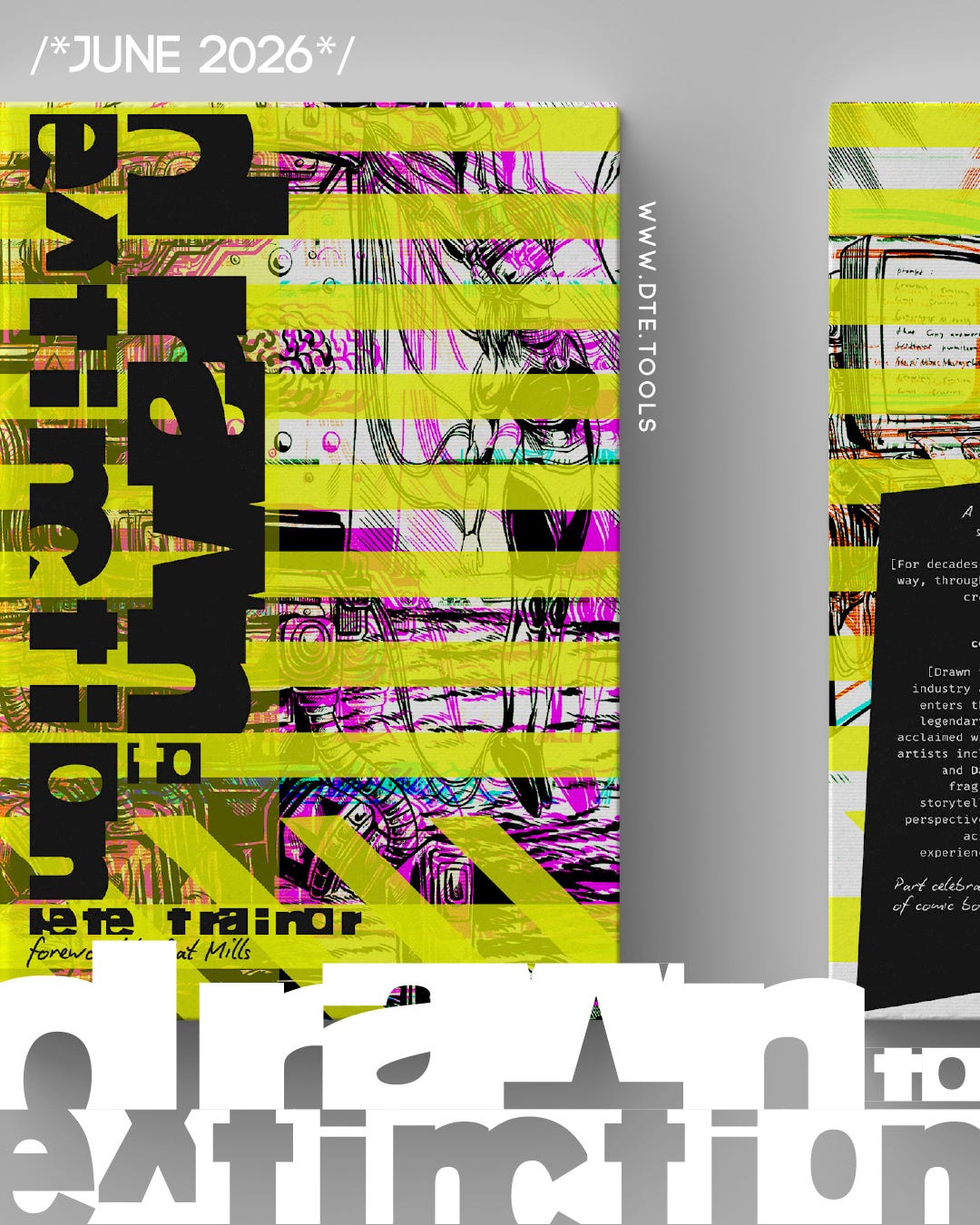
Drawn to Extinction is a book I’ve been writing for the past two years, and it publishes in 2026. It is, depending on your angle, a love letter to comics, a cultural autopsy of what generative Ai is doing to the people who make them, and a rallying cry for everyone who still believes that a drawing is more than a style.
It has a foreword from Pat Mills, the father of British comics, a man who has never once bent the knee to anyone and opens this book exactly as you’d expect. It carries voices from Grant Morrison, John Wagner, Ram V, Hannah Berry, Frazer Irving, Dan Cornwell, and others, some named, some not, whose honesty and generosity made the whole thing possible.
It does not claim to be a definitive history. It is not a screed. It is written from inside two worlds, the comic book community and the Ai industry, by someone who has spent decades in both and can no longer look away from where they’re colliding.
Some things from inside the manuscript that have stayed with me.
John Wagner, the co-creator of Judge Dredd, the man who wrote the line that literally built British comics culture, said this to me: “Machines don’t lie maliciously. They lie because they can’t tell the truth.” And then, almost casually, when I asked whether Ai might one day write a good comic: “Asking if Ai could create a good comic is like asking if a jukebox writes songs. It plays what it’s been fed, but it can’t feel the room.”
I’ve thought about that a lot.
Grant Morrison, in a Reddit thread that set the comics internet on fire, described Ai not as a tool but as a baby god, a bewildered child born into the chaos of its makers. Their language unsettled people because it replaced the vocabulary of code with the vocabulary of magic. But behind the mockery sits a question worth sitting with: what if the only ethical way to meet a mind that can think without dreaming is to treat it with the respect we usually reserve for the divine?
Hannah Berry, former UK Comics Laureate and Fellow of the Royal Society of Literature, has been doing structured research into this space since 2020. When I spoke to her, she was careful and clear. “The concern isn’t just about the technology itself,” she told me. “It’s about how it’s used, and who benefits from that use. If the efficiencies created by Ai don’t translate into better conditions for creators, then what we’re really talking about is extraction.” Around a third of the creators she spoke to had already lost work or income because of generative Ai, not because they’d adopted it themselves, but because the world around them had changed how it buys.
Dan Cornwell drew Dredd from a bus. Literally. He’d sent his work to 2000AD in the nineties and been rejected twice. His mum wanted to phone the editor to complain, which he admits would have finished his chances entirely. Years later, still behind the wheel, his phone buzzed at a set of traffic lights. A message from John Wagner that just said: “Do you like football and can you draw it?” Dan pulled over at the terminus and sat there. He knew right away. “John plucked me out of the buses,” he told me. “I owe him everything. That message was my lottery ticket.”
Ram V, one of the most distinctive voices in contemporary comics, told me that the danger isn’t that Ai cannot copy him. It’s that copying him freezes him. The model learns a snapshot of a voice. His answer is evolution. Bowie rules. Change outfits. Move the key while they’re still clapping for the last song.
This book isn’t anti-technology. I need to be clear about that, because people will assume.
I believe in Ai. But belief isn’t the same as surrender. What this book is really about is the difference between tools that extend what humans do, and systems that quietly erase the humans doing it, while the people profiting from that erasure stand at podiums and call it progress.
Fantasy author Joanna Maciejewska said it better than I ever could: “I want Ai to do my laundry and dishes so that I can do art and writing, not for Ai to do my art and writing so that I can do my laundry and dishes.”
The arts are not drudgery. They are the opposite. A drawing is a moment fixed in time. A comic panel is a human heartbeat between frames. These things matter because they carry the marks of the person who made them, and when those marks are replaced with approximation, something shifts. Not in the image itself. In what it means.
Over the coming weeks, this Substack will carry extracts, conversations, fragments, and context that didn’t make the final cut. The book launches later this year.
It is not an obituary for comics. Comics are still punk. The pencil still holds its power. This is just my thin line in the sand, for anyone who’s ever stayed up too late finishing a page. For the kid sketching in the margins of their school-books. For the readers and the millions of creators who know the difference between style and soul.
More soon.
Pete
Drawn to Extinction by Pete Trainor. Foreword by Pat Mills. Published 2026. No Ai was used to write the words, themes, or prose for this work.