


The London Comic Mart comes round every few months, and the part I go for isn’t the graded slabs or the key issues in mylar, it’s the boxes that sit just down to the side of the main tables where the dealers dump the cast-offs. The literal bargain bin that always has the occasional vintage British comic that never sells online because nobody can be bothered to list it properly. I don’t go digging around in them to buy loads, but I usually find one item that I end up buying with my dad in mind because he’s eighty now, and he was exactly the right age for this stuff when it was first getting realised. Turning up at his house with something he hasn’t held in sixty years starts a better conversation than anything I could bring him from a shop. That’s the back-drop.
Like so many in attendance, I stand there flipping through boxes and issues, and every so often a cover or interior stops me dead and I buy it. Then I spend the rest of the day trying to work out who drew it, which is harder than it sounds, because the credit isn’t always there, and never was.
If you’ve got an eye for this stuff, and you’re nerdy enough like me you go looking for the tell; The way somebody handles a face in three-quarter profile, the particular impatience in how they render rubble, whether the horses look like horses or like large anxious dogs (hat-tip Frazer Irving who hates a horse to draw). Occasionally you land it, most of the time the page just sits there being beautiful and unclaimed which is its own small kind of insult.
I used to assume the anonymity of old issues was laziness, cheap paper and cheap production and nobody at the publisher who could be bothered, which turns out to be almost the opposite of the truth.
The real story runs through a first-floor office on Farringdon Road that most people who love British comics have never heard of.
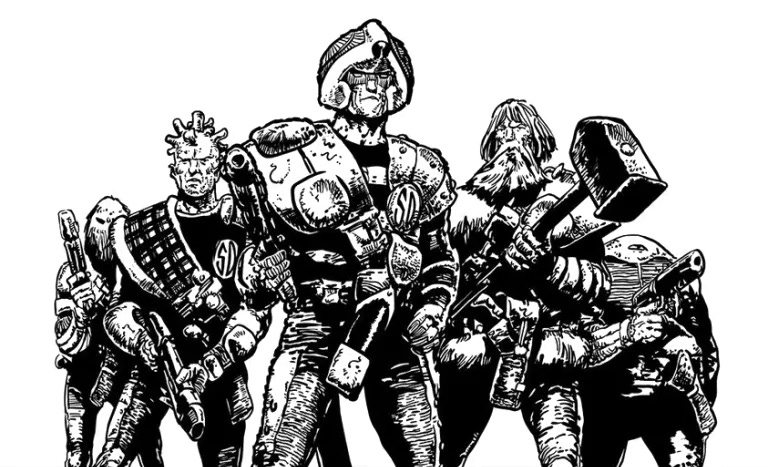
Seventy artists and one phone number
The agency was called Bardon Art. It was set up in 1957 by Barry Coker, who’d been an editor at Amalgamated Press, together with a Spanish artist named Jordi Macabich, and it sat a short walk from the Fleetway offices, which was not an accident. By the 1970s Bardon represented more than seventy artists. It kept working relationships with Fleetway and DC Thomson right through the eighties and nineties as the market shrank around it, and it only closed in 2010 when Coker finally retired.
Almost all of the artists on Bardon Arts’ books were Spanish.
Not some of the artists on some of the titles, either. A very large share of what British children read in the sixties and seventies (the war libraries, the romance weeklies, the westerns, the adventure strips) was drawn in Spain, shipped to London, and printed with nobody’s name on it. Jesús Blasco. José Ortiz. Luis Bermejo. Jordi Longarón. Jordi Peñalva. Even Enric Badía Romero, who would later draw Modesty Blaise. A generation of British readers grew up thinking they were looking at British comics, and in the sense that mattered commercially they were, while in the sense that mattered artistically half the hands belonged to men working in Barcelona who had never seen a British newsagent.
The economics were simple enough, and if you’re honest about it, quite funny. The exchange rate meant a British page rate went a very long way in Franco’s Spain, so the work paid properly at the Barcelona end while remaining cheap at the London end. Everybody won except the artist’s byline. If a modern startup described this arrangement in a pitch deck, you’d nod along politely and think, ah, labour arbitrage with a routing layer, we’ve all built one of those.
And it wasn’t a con, which is what keeps this from being a straightforward story about villains. Coker is spoken of warmly by people with no reason to flatter him, including Brian Bolland and Dave Gibbons, both of whom he also represented. He got artists paid, he got them work, and he got the work back across a border in an era when that involved actual physical parcels. The anonymity wasn’t his doing, it was house policy at the publishers, and it applied to British artists too, because nobody signed anything, and signing things gave you leverage.
My favourite detail in the whole business belongs to José Ortiz, who drew a newspaper strip about a barrister for the Daily Express and reportedly came over to Britain specially so he could sit in a magistrates’ court and sketch it properly. A Spanish artist flying in to draw the correct sort of English courtroom furniture, for a strip credited to a “famous barrister” who was in fact a Scottish scriptwriter. There is no version of that arrangement that a machine would ever have thought was worth the airfare.
The page that carried nobody’s name
Carlos Ezquerra was born in Ibdes, in the province of Zaragoza, in 1947, and started his career in Barcelona drawing westerns and war stories for Spanish publishers. In 1973 he got into the British market through Barry Coker, and the work he got was not glamorous. Romance comics, Valentine and Mirabelle. Westerns for a pocket library. Adventure strips for DC Thomson’s The Wizard, none of it carrying his name. He liked it enough, or found the exchange rate confusing enough, that he moved to Croydon with his wife rather than stay in Spain and post the pages over.
In 1974, Pat Mills and John Wagner went looking for artists for a new title called Battle Picture Weekly, and they headhunted Ezquerra on the strength of that uncredited Wizard work. Two editors looked at pages signed by nobody, decided the hand behind them was worth having, and went to an agent on Farringdon Road to find out whose hand it was.
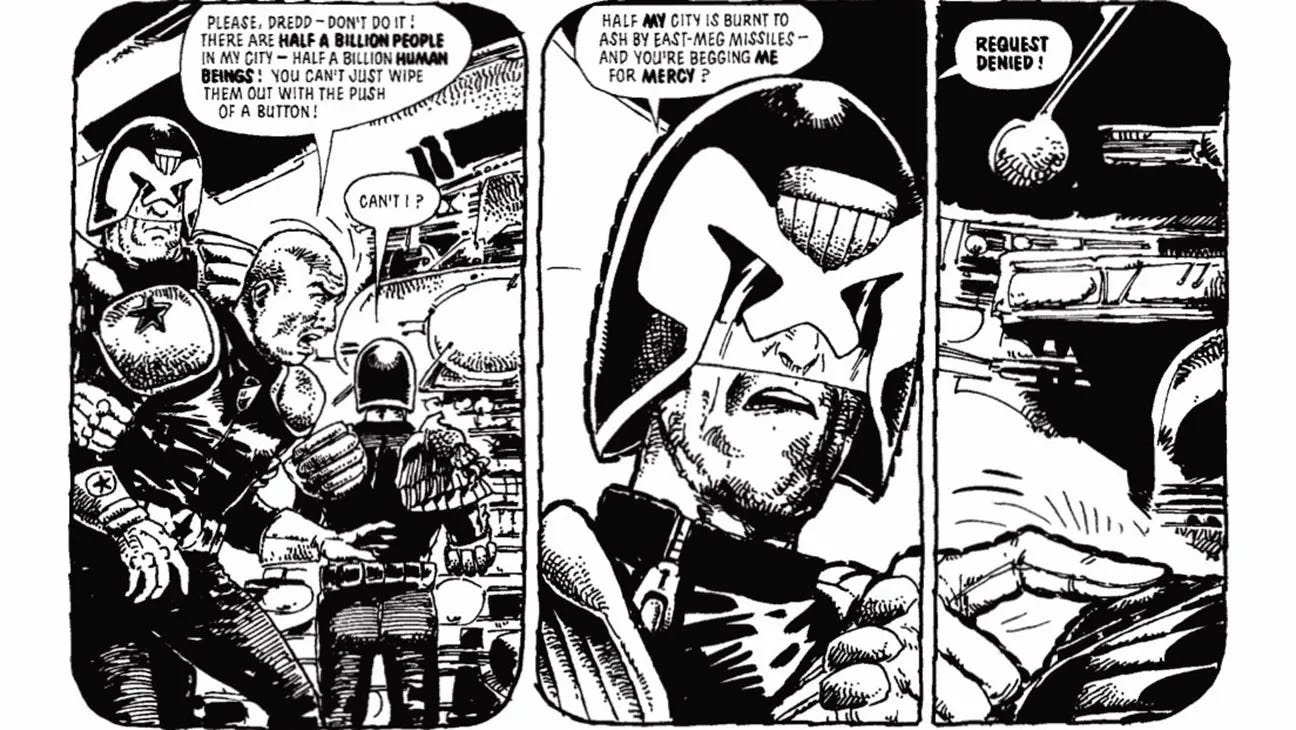
Three years later that hand designed Judge Dredd.
The most recognisably British character in comics, the boot and the badge and the sneer that came to stand for Thatcher’s Britain looking back at itself, was visualised by a Spaniard in Croydon who’d been hired off an anonymous page in a boys’ weekly. He later said it was a shame he and Wagner never owned Dredd, then immediately talked himself round to the view that if they had, fewer artists and writers would have got their start drawing him. He was pragmatic to the end about an industry that had quietly extracted a fortune from him. Inside Fleetway, he pointed out, it made no difference which title you worked on. The pay was the same either way.
The bit that complicated my own argument
I just spent the best part of two years writing a book arguing that generative Ai is pulling away the ladder, that it removes the low-paid, unglamorous, invisible work where people used to learn their craft before anyone knew their name. So when I went digging in the past I spotted that the ladder I was mourning was already anonymised for a lot of artists. It was already offshored, already priced against a favourable exchange rate and routed through a middleman so that the commissioning editor never had to think about the person at the other end. The comics industry didn’t need a language model to invent that arrangement because it had one running out of an office near Farringdon station for fifty years, and it liked it.
If you want to be uncharitable about it, and I do occasionally, you could say the industry spent half a century building exactly the supply chain that generative Ai now offers, and the only real innovation is that the supply chain no longer needs to eat.
There’s a leak in the old system, though, and I think it matters more than anything else in this story, because it’s the reason the comparison eventually breaks down.
The editor who could recognise a hand
Every anonymous supply chain contains somebody who can tell the difference, and that’s the flaw in it, the one worth being sentimental about. Mills and Wagner could look at an unsigned page and know that a specific person had made it, that the person was good, and that they wanted them. The credit was missing but the fingerprint wasn’t, and the fingerprint was enough to pull a man out of romance comics and into the creation of a character that’s still earning money half a century later.
Dan Cornwell put it to me better than I could, talking about following Ezquerra on a strip after he died. “You can trace Carlos, sure. You can’t be him.” He’s right, and the reason he’s right is that a style is a residue of a person, the accumulation of everything they habitually do slightly wrong under deadline pressure, which is why you can spot it at ten paces even when nobody has signed the thing.
“You can trace Carlos, sure. You can’t be him.”
Dan Cornwell, Drawn to Extinction, 2026
So an editor’s eye was never really about judging quality in the abstract. It was a detection instrument, tuned over years to find the human being hiding inside an unattributed page, and it worked precisely because the industry had given it so much practice. Nobody is going to look at a generated image and say, find me whoever drew that, and that’s a structural difference rather than a romantic one. Taste leaks talent upwards through any system that still has people in it, constantly, whether or not the system intends to let it. Take the people out and there’s nothing left to detect. The pages arrive, they’re adequate, and there’s no hand underneath to go looking for.
Do me a favour and go dig out something cheap and unsigned from a box at Comic Mart. A war library, a girls’ weekly, whatever’s going for a quid in a long-box at the next con. Look at it properly, try to work out who drew it, and then go and find out whether anybody has bothered to attribute it since. A great deal of this work is still sitting there unclaimed, and the names are often recoverable, because the people who made it are documented even where the pages aren’t. Put one name back on one page. It’s more than the industry managed at the time.
Sources worth your money if you want to go deeper: Illustrators Quarterly issue 22 is a Bardon Art special researched by Diego Cordoba with Barry Coker’s direct testimony and an introduction by Dave Gibbons.
Steve Holland’s Bear Alley is the standing authority on British comics attribution, and downthetubes has run first-hand accounts from people who dealt with Bardon at the Fleetway end.
What a fantastic read, thank you!
Oh, and I always go through the ‘forgotten’ boxes myself as there’s always gold in there to read!
Another delightful piece. I'm loving these. 100% agree. Cheers!