

They Didn’t Hate the Film. They Hated the Woman in It.
I saw Supergirl today and it wasn’t perfect, but the backlash has almost nothing to do with the film — read on, the data makes that point uncomfortable to ignore.

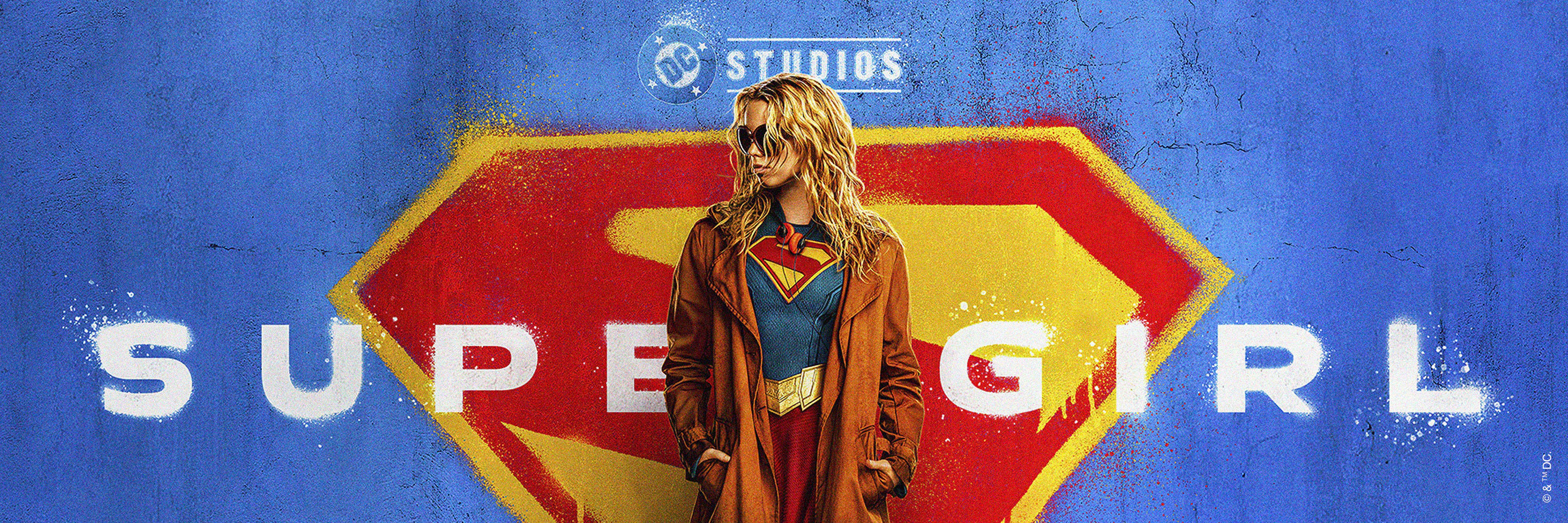
I should start with a confession because this piece is trying to be honest and honesty has to cut both ways; I have spent most of my comic-reading life inside a very particular corner of the medium, one that skews heavily male, heavily towards the characters I grew up with, and I’m so acutely aware of that now my 13-year-old daughter is digging around in my substantial graphic-novel collection looking for heroes and only finding jocks. For a long time, that reading bias has also quietly followed me into the cinema, and female-led superhero films were things I’d catch eventually on a streaming service, half-paying attention, rather than things I’d clear a Friday evening for. I’m working on that. Actively. Because the more I’ve paid attention, the more I’ve realised how much that kind of lazy default costs both personally, in terms of the stories you miss, and culturally in terms of what it tells the industry about what’s worth making.
I mention this because it matters for what follows. I’m not writing this from a position of pure detachment. I went to see Supergirl which is loosely based on Tom King and Bilquis Evely’s comic Supergirl: Woman of Tomorrow, and I came out with a strong view, not just about the film, but about what’s been done to it before most people had the chance to see it for themselves.
The Film, First
Supergirl is a flawed piece of work. The script is uneven, and the second act loses its nerve somewhere between a cosmic road trip and a meditation on grief… it can’t quite commit to either, which is the films biggest flaw. The villain is underwritten to the point of near-absence. These are real creative problems, and critics who’ve flagged them aren’t wrong.
But Milly Alcock’s performance is genuinely extraordinary. She plays Kara Zor-El as someone still carrying the weight of watching her planet die before she ever set foot on Earth, someone who finds moments of fierce, scrappy joy without ever quite shaking the sadness underneath. It’s not the Supergirl of Saturday morning cartoons, it’s darker and stranger and more interesting than that, and it’s exactly the version the source material called for. Jason Momoa, meanwhile, appears to be having the time of his life as Lobo, and the film has a cosmic, interstellar scale that GotG got right, but most superhero films don’t attempt.
I found it absorbing. I also found it imperfect. Both things are true, and I think holding both at the same time is the only honest response to what’s been happening around this film.

The Numbers
Before we talk about the noise, the data deserves to be seen clearly.
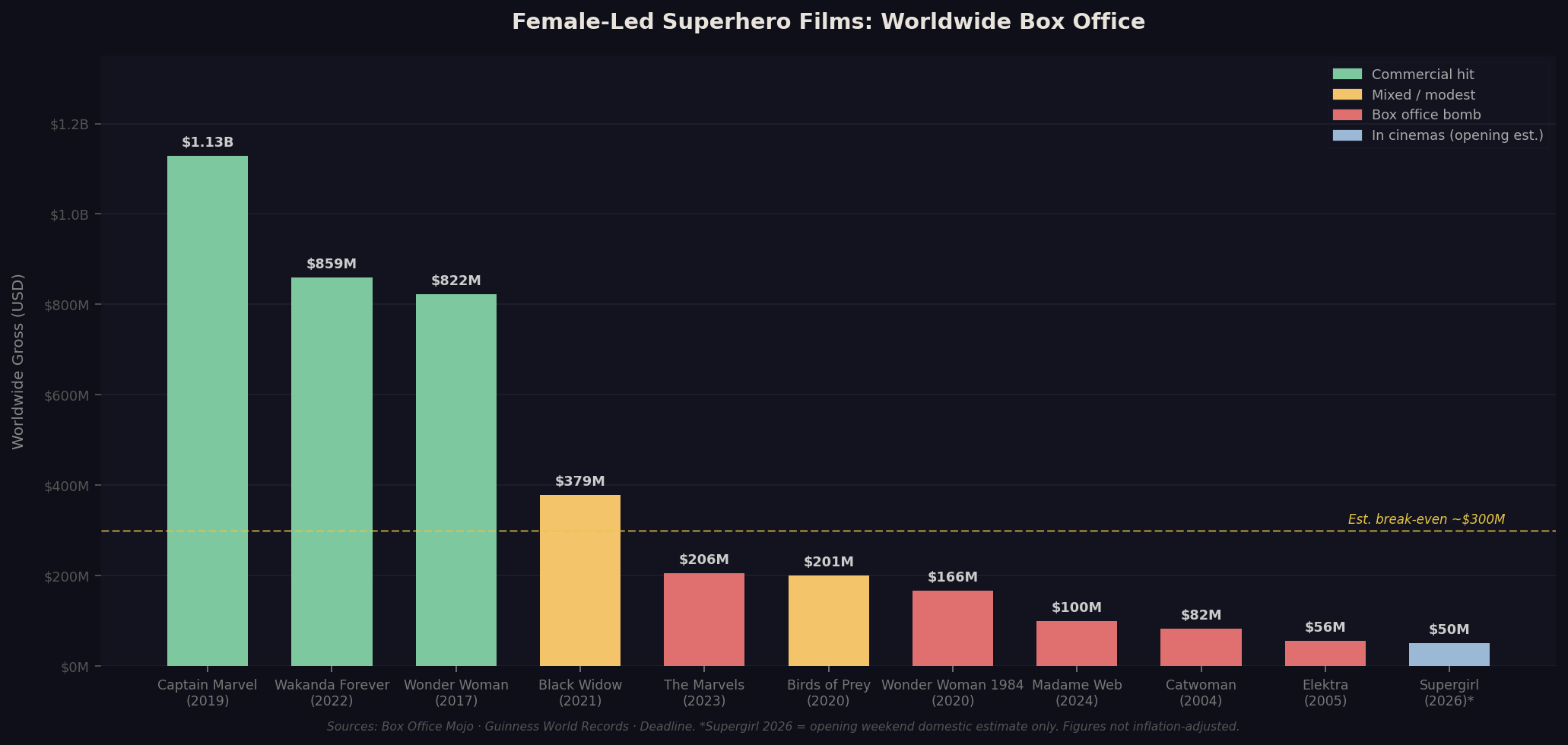
Sort that chart by revenue and the first thing you notice is that the top of it is not a graveyard. Captain Marvel earned $1.13 billion worldwide — the first female-led superhero film to cross a billion dollars — and Wonder Woman earned $822 million, becoming at the time of its release the highest-grossing live-action film ever directed by a woman. These are not asterisked successes, these are dominant performances by any metric.
Look at the films that fell short and a different pattern emerges: Catwoman bombed in 2004, Elektra limped out with $56 million in 2005, Wonder Woman 1984 was hobbled by a pandemic-era release, The Marvels ended its run at $206 million against a reported $275 million production budget. Each of these failures is real. But here is the thing the discourse always skips over: not one of them failed because a woman was at the centre. Catwoman failed because it was a genuinely terrible film with an 8% Rotten Tomatoes score. Elektra failed because it was a low-ambition spin-off nobody believed in, including the lead actress. The Marvels failed because the MCU had been haemorrhaging audience goodwill for two years through an over-saturated streaming slate, and because the creative conditions weren’t in place. The gender of the protagonist was not the variable.
Now look at Supergirl’s opening: an estimated $40–50 million domestic, landing at number two behind Toy Story 5’s second weekend, with a reported production budget of $170 million. By the logic of the online discourse, this is a disaster. By any other reading, it is a modest opening for a mid-franchise DCU film opening against stiff family competition, with a 57% critics score that had been generating negative headlines for weeks before the film arrived.
Critics vs. Audiences: The Gap That Tells the Story
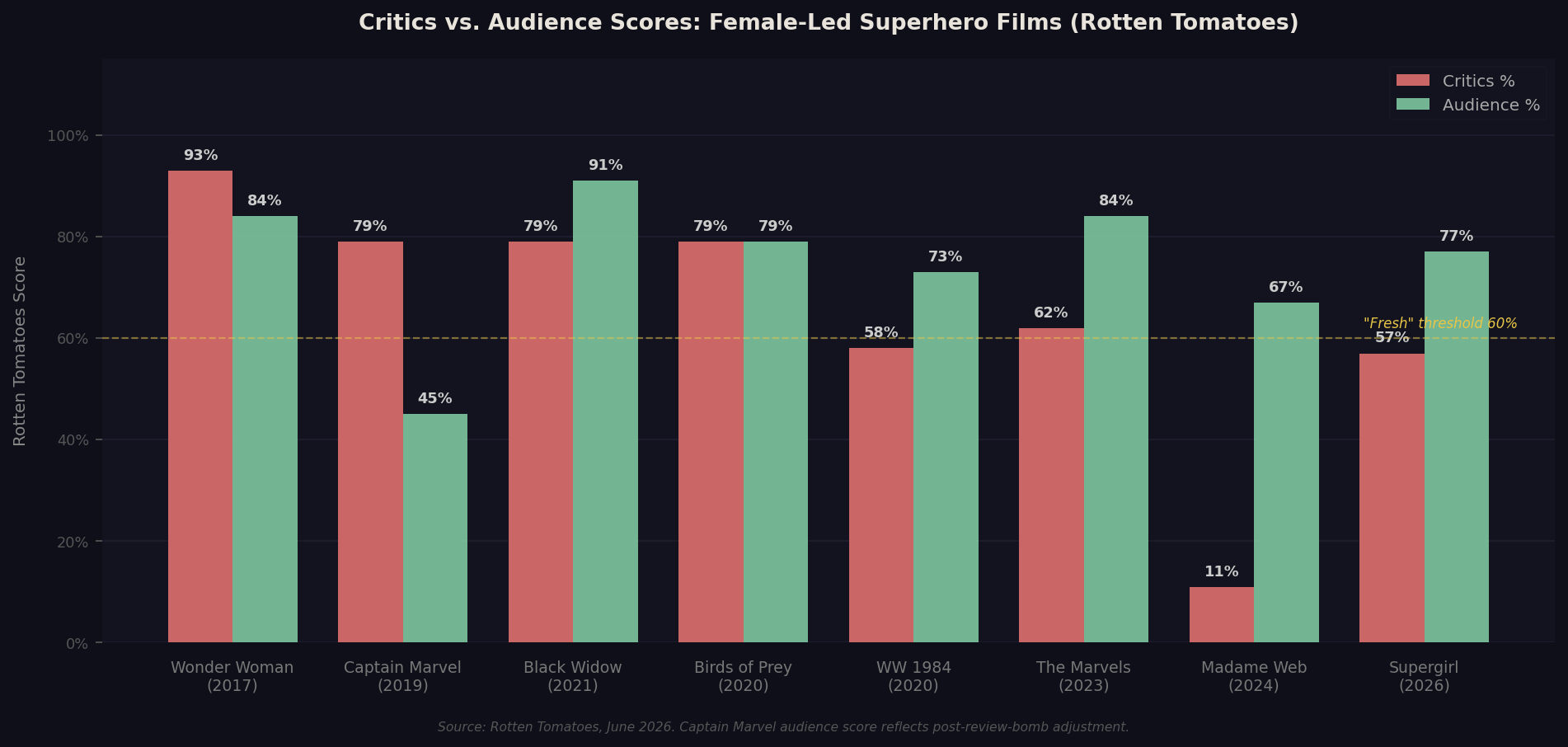
That second chart is the one I keep coming back to. Supergirl sits at 57% with critics and 77% with audiences — a 20-point gap. That is not a random divergence. Look at what else shows a pattern: Captain Marvel’s audience score was actively manipulated downward through coordinated review-bombing before most people had seen the film. The Marvels’ audience score is higher than its critics’ score. Madame Web (which is a genuinely poor film by any standard) has an audience score of 67% against an 11% critical rating, which suggests even there, the people who actually paid to sit in the seats found something the critics, primed by months of negative anticipation, had stopped looking for.
Critics are not a monolith and most of them are doing their jobs as honestly as they can. But critics also exist within a cultural conversation, and that conversation around Supergirl had been poisoned months before the first review was written.
What They Actually Said About Milly Alcock
Before the film reached a single paying audience, Milly Alcock had been subjected to months of sustained personal attack online, none of it related to her ability as an actress. People criticised her teeth at the world premiere. They circulated memes comparing her face to a character from a 1970s Saturday morning television show — a comparison that former Superman actor Dean Cain engaged with and was then criticised for, in a cycle that tells you everything about the energy driving these conversations. Promotional posters were edited to make Supergirl’s costume shorter. Her decision not to perform a specific kind of polished feminine presentation on red carpets was treated as a casting failure.
Alcock was clear-eyed about it. “I knew that by simply existing as a woman in franchise IP, I was going to get backlash,” she told Variety. She observed that most of the hostility came from anonymous accounts, the burner profiles and the “Dad of four, Christian” bios, and arrived at the only sensible conclusion available: “If you’re pissing the right kind of people off, you’re doing OK.”
It is worth being specific about what this backlash was not; It was not disappointed comic book fans with a genuine creative argument about the adaptation, it was a cohort that has spent years developing a playbook for generating pre-release negativity around properties featuring women, people of colour, or any character who doesn’t conform to a very specific vision of who a hero should be and who they should desire. Captain Marvel received exactly this treatment in 2019 and still earned a billion dollars. The machine is loud. It is not necessarily representative of anyone who actually watches films.
The Comparison Nobody Is Making
Here is a fact that has been almost entirely absent from the Supergirl discourse though, the biggest breakout film of this summer, the one that has earned $220 million globally against a production budget of $750,000, that has a 94% Rotten Tomatoes score, that audiences have been returning to in their second and third weekends while word of mouth turned it into a genuine cultural event, is Obsession.
Obsession, directed by YouTuber Curry Barker and starring Inde Navarrette as Nikki, is a horror romance whose entire engine is the perspective and interiority of its female lead. Navarrette has been in virtually every frame of the film’s promotional material. The story is driven by her experience, her psychology, her survival. It is, in every meaningful sense, a female-led film, and it has become the highest-grossing movie picked up at a film festival since The Blair Witch Project, besting the global cumulative totals of Get Out and Smile. Nobody is writing hot takes about how Obsession’s success disproves the female-led film thesis. Nobody is generating memes about Inde Navarrette’s appearance. The online hostility machine has not trained its sights on her, and the film has been allowed to find its audience on its own terms.
The difference, of course, is that Obsession is not a superhero film. The cape and the mythology and the decades of male precedent attached to them are apparently what triggers the territorial response. A woman in a horror film is allowable, a woman flying in the suit is not.
The Pattern Studios Keep Ignoring
When female-led superhero properties are given first-rate creative conditions, they succeed. Wonder Woman had Patty Jenkins, a strong screenplay, and genuine studio belief. Captain Marvel was positioned as the bridge between Infinity War and Endgame and given the full weight of MCU machine-hype. Both broke records. The films that struggle tend to be the ones where those conditions weren’t in place, where the script was underbaked, where the studio hedged its bets, where the marketing felt like obligation rather than enthusiasm.
And yet in almost every case, when a female-led superhero film underperforms, the failure gets attributed to the gender of the lead rather than to the creative decisions that determined the film’s quality. That attribution is not just factually wrong, it is useful to specific people, because it lets the industry off the hook for its own creative failures while simultaneously discouraging further investment in female-led stories. It is a self-reinforcing mechanism, and it has been running for long enough that people have stopped noticing how it works.
The uncomfortable truth is that the dudes will show up in higher numbers for a male-led film, that is a documented reality of the current superhero market, and pretending otherwise doesn’t help anyone. But the gap is not as wide as the industry fears, and it is being actively widened by the online campaigns that poison the pre-release conversation, tank the critical discourse, and ensure that organic fan enthusiasm (the kind that can carry a so-so script into a genuine cultural moment) never gets the chance to build. Male-led superhero films coast on decades of accumulated goodwill and the simple social permission that comes from never having had to fight for your right to exist. Female-led films don’t get that same runway, and when they stumble, the stumble is treated as evidence of structural failure rather than the product of the specific circumstances that caused it.
What the Film Is Actually About
I want to end where I started, with Milly Alcock flying across an alien sky, looking like someone who has earned the right to be there through grief and stubbornness and a refusal to tidy herself up for anyone.
The stories we tell about superheroes have always, at their best, been about people who carry more than they should have to carry and carry it anyway, who protect those who cannot protect themselves, who refuse to accept the world as it is. Kara Zor-El arrived watching her planet die, and she carries that into every fight, she does not smile on cue, and she does not perform her powers for an audience’s comfort, and she is all the more interesting for it.
The people who spent months trying to ensure this film failed before it opened were not, at bottom, making a creative argument, they were making a territorial one: the cape belongs to a particular kind of person, and Alcock’s Supergirl is not that person, and that is exactly why she is worth watching.
The film is in cinemas now. I’d recommend seeing it before you let anyone else tell you what you think of it.
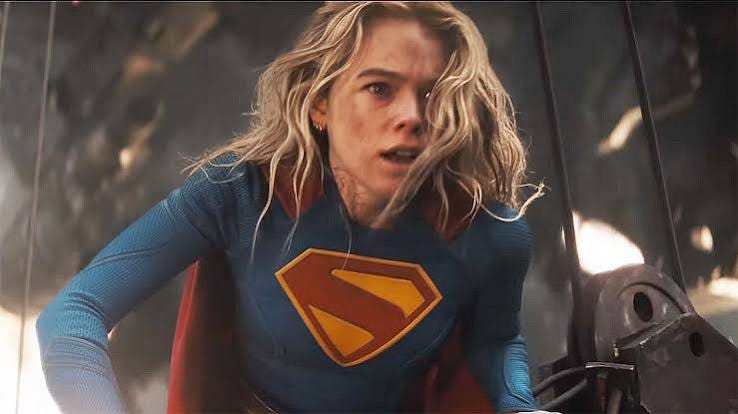
Box office data: Box Office Mojo, Guinness World Records, Deadline Hollywood. Rotten Tomatoes scores as of 27 June 2026. Obsession box office data: Variety, Hollywood Reporter, Deadline. Supergirl 2026 opening weekend estimate: Deadline / industry tracking.
Magnificent review and overview, Pete. Thank you.