We've Been Here Before.
What the comics industry tried to tell us in 1990, and what every creative profession is about to learn the hard way.

In the late eighties, the comics industry tried to have a conversation with itself about who actually owns the work. It went badly.
The people who turned up for it were the right people. Alan Moore, mid-flight on Watchmen, watching a contract he’d signed in good faith quietly mutate into a perpetual annuity for someone else. Steve Bissette, fresh from Swamp Thing, beginning to understand that the paperwork he’d put his name to didn’t just take the character away from him, it took the authorship away too. Scott McCloud, who would spend the next four decades trying to explain comics to people who hadn’t bothered to look properly. Dave Sim, before Cerebus curdled him into someone harder to sit next to. Kevin Eastman, whose Turtles money meant he could put his shoulder behind something the rest of them couldn’t afford to. They gathered at a summit in Northampton, Massachusetts in November 1988, and they drafted a Bill of Rights for Comics Creators. Twelve points. Plain language. The right to own what you make. The right to control how it’s reproduced. The right to be credited. The right to approve the promotion of yourself and your work. The kind of document that sounds so reasonable you almost miss how radical it was simply to need it.
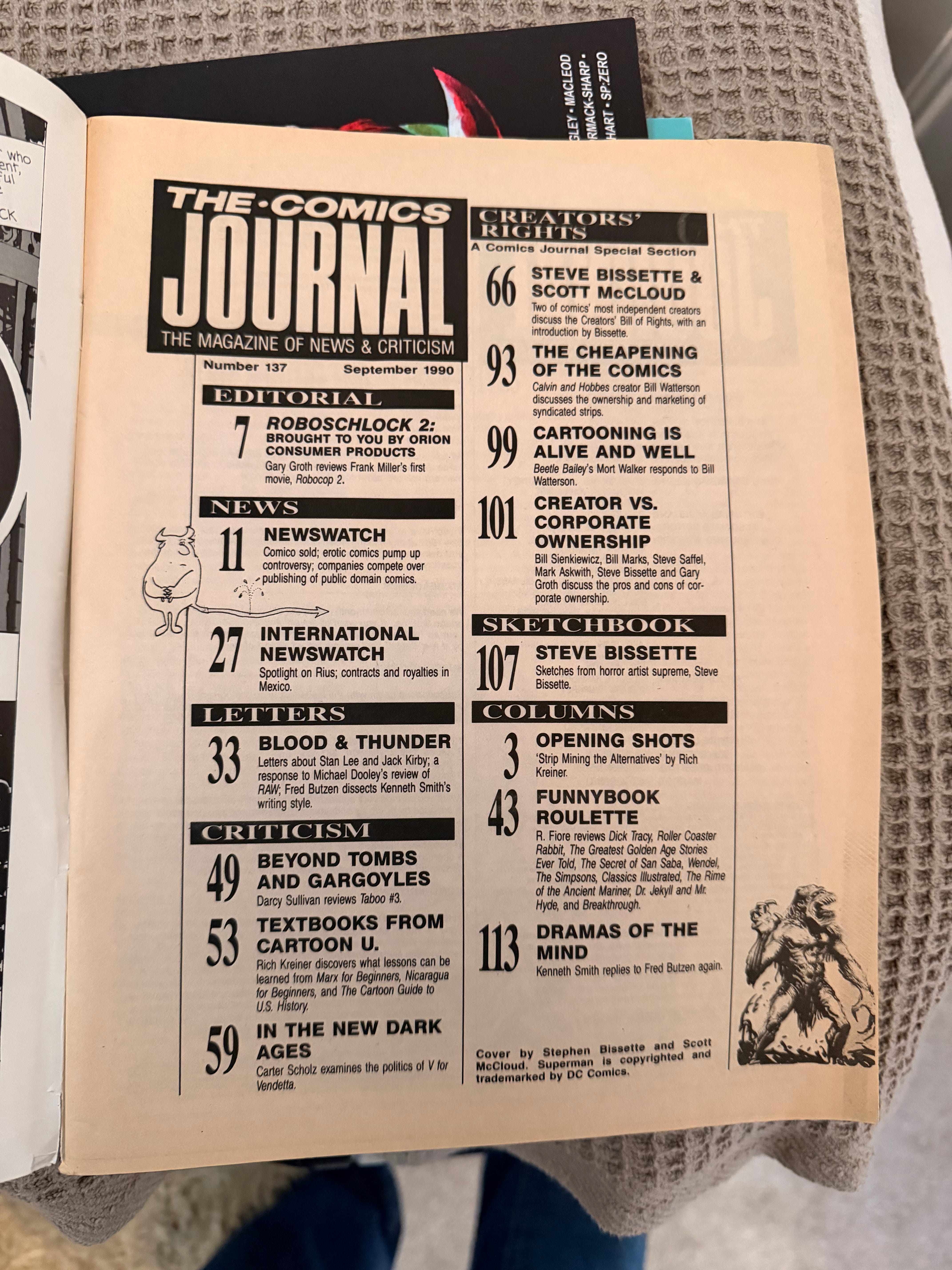
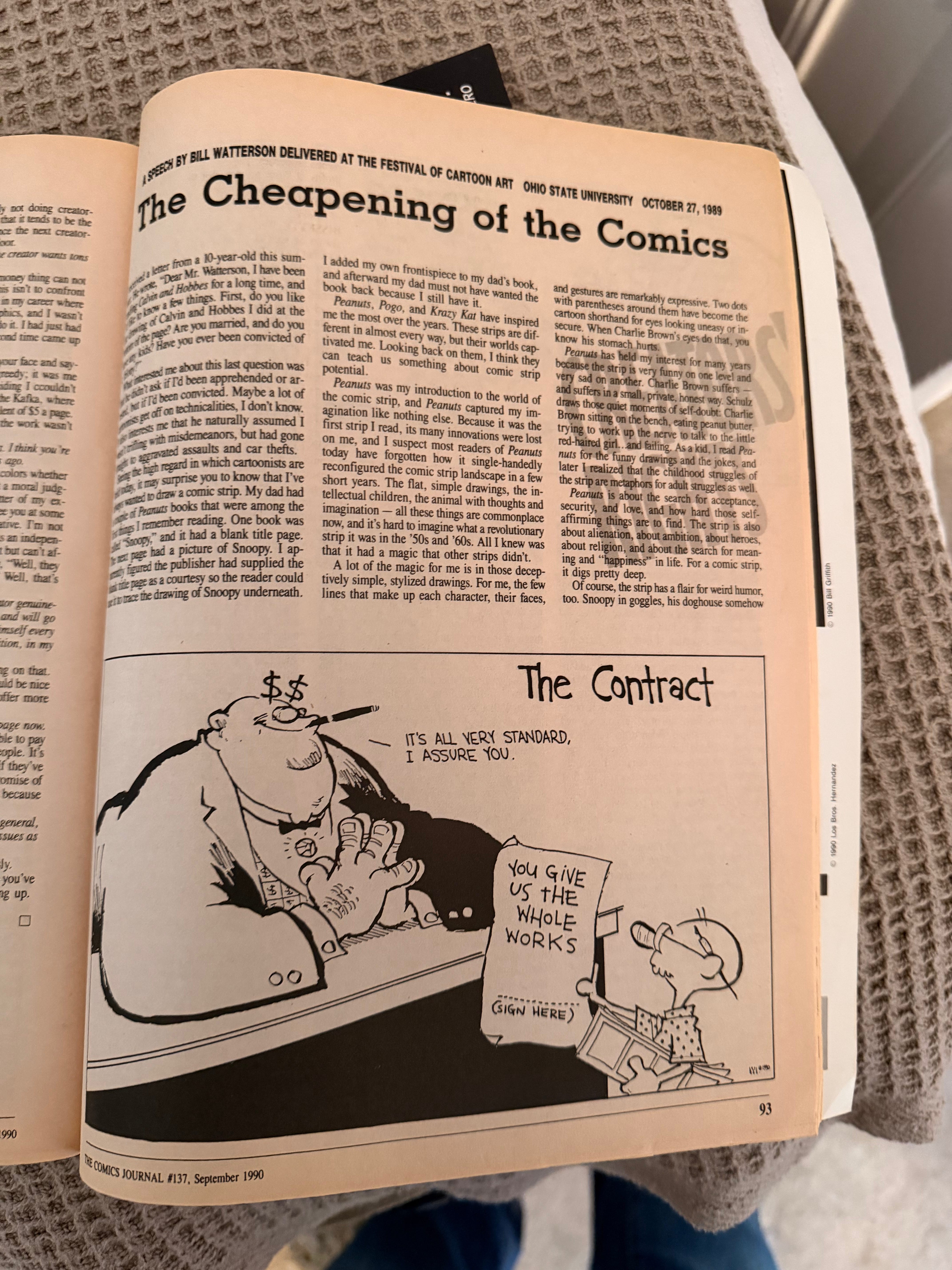
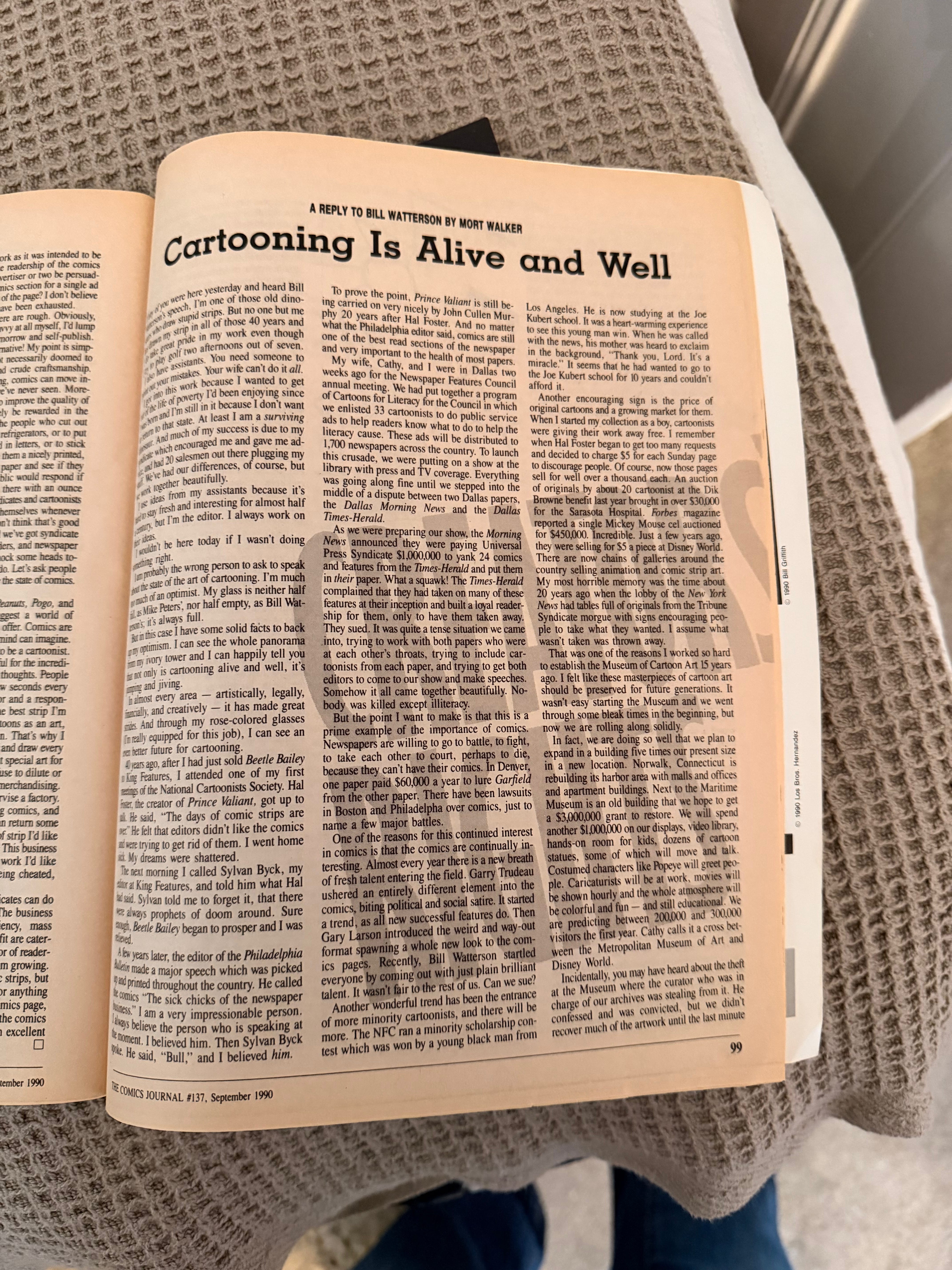
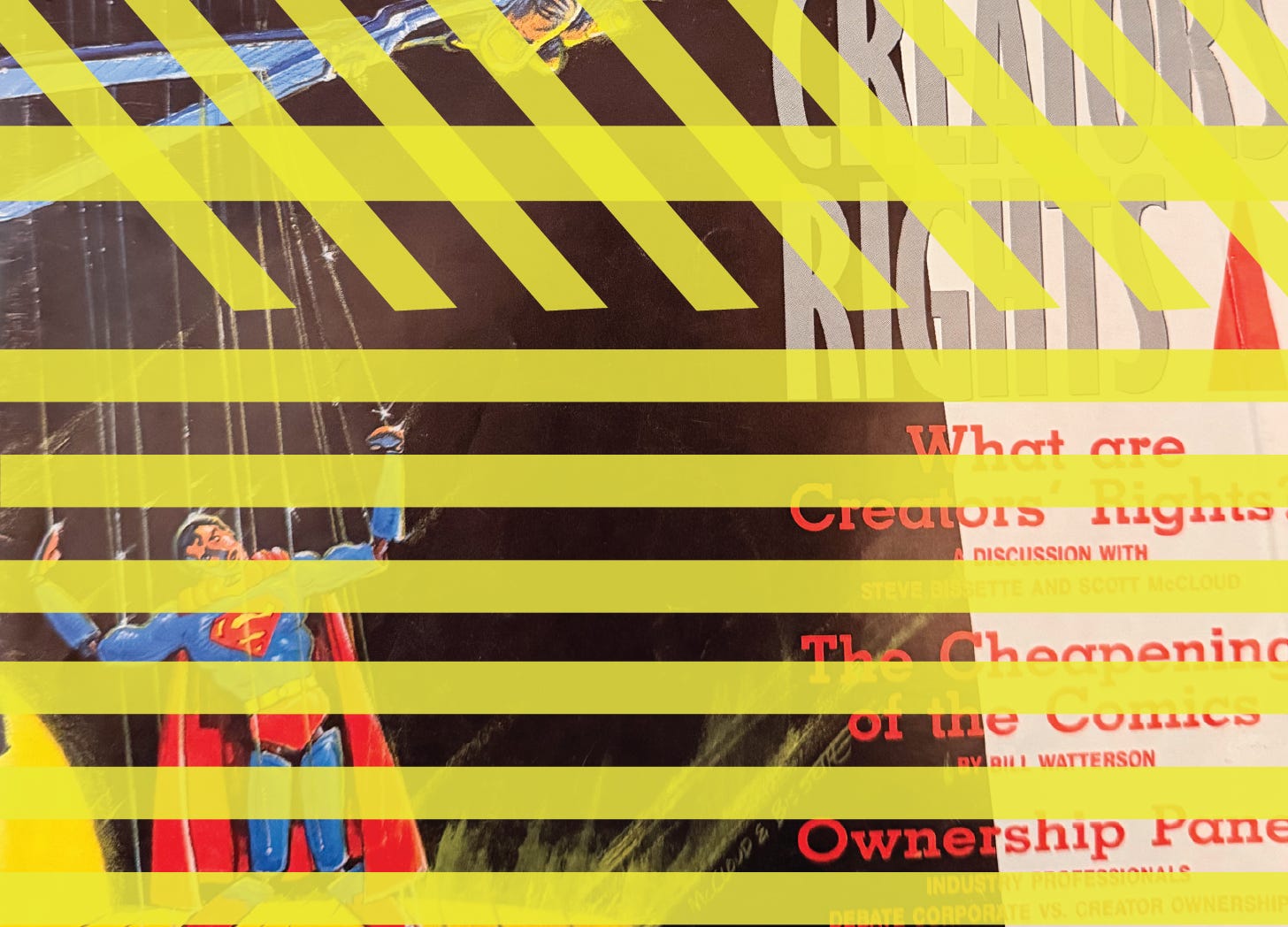
A year later, at a panel in Toronto chaired by the writer Mark Askwith, some of the same names sat onstage with the people who ran the publishers and tried to argue the principles out in public. Gary Groth from Fantagraphics, Bill Marks from Vortex, Steve Saffel from Marvel, Bill Sienkiewicz, Bissette again. The transcript was published in The Comics Journal the following September. I have a copy of that issue on my desk as I write this. I bought it at auction, partly because it’s a beautiful object, partly because the cover painting by McCloud and Bissette shows Superman as a marionette with a giant corporate hand holding open scissors above his strings, and partly because the room it documents is one of the most poignant rooms in the history of the medium.
Poignant because they were right, and because almost nothing changed.
Groth, near the start of that panel, on why his publishing house had never owned a creator’s work: it doesn’t do the artist any good, it doesn’t do the public any good, it only ever does the corporation any good. Sienkiewicz, on the slow realisation of what he’d signed: the more I did it the more I realised that I couldn’t continue on this way. Bissette, on the legal fiction of work-for-hire: we signed away the fact that we wrote and drew the book. Read that sentence twice. He’s not saying they took our credit. He’s saying we signed a piece of paper that legally redefined who made the thing. The hand that drew it became, in the only sense the courts cared about, a hand that hadn’t.
Groth, in his closing remarks, landed the verdict. The companies, given that they had the power to dictate the terms, treated the creative talent in comics like serfs.
That was 1989. The Bill went into the archive. Kevin Eastman tried to build a publisher around its principles. He lost fourteen million dollars and it folded in three years. The contracts didn’t change. The page rates didn’t change. The work-for-hire model didn’t change. The men in that Toronto room won the argument, intellectually, comprehensively, and then went home and discovered the argument hadn’t actually been the thing. The thing was the leverage, and the leverage was elsewhere.
I want you to hold all of that in your mind for a second, because I’m about to fast-forward thirty-six years.
Hannah Berry is a former UK Comics Laureate and a Fellow of the Royal Society of Literature. She still makes the work. 5 More Minutes, her short piece about parenthood and existential dread, is one of the most disquieting things published in any medium in the last decade, and you can read it in about the time it takes to drink a cup of tea. Hannah also does something most working creators don’t have the energy for, which is sustained research. In 2020 she ran a structured study of UK comics creators and their relationship to emerging technology. In 2025 she went back and did it again, with the same rigour, to see what had moved.
What she found should be the headline of every piece written about generative Ai and the creative industries in 2026, and isn’t.
The creators are not using it. Across five years of unbelievable hype, of cover stories and conference keynotes and confident predictions that the tools were about to revolutionise the form, almost none of the people actually making British comics had integrated generative Ai into their practice. This is not technophobia. The same industry adopted digital colouring, lettering software, online distribution, the lot, the moment those things genuinely helped. This feels different, Hannah told me when we spoke for my book. Different because the tools don’t extend the hand. They attempt to replace it.
And here’s the part that should make the rest of us pay attention, whatever we do for a living.
Around a third of the creators in her research have already lost work or income to generative Ai. Not because they’re using it. Because the people who used to pay them are. The small commissions vanish first. The local band poster, the small press cover, the character design someone would have happily paid for a year ago. The hidden scaffolding of a creative career, the work that sits between bigger projects and quietly keeps a freelancer solvent. It doesn’t go with a bang. It just stops. The emails stop. The small jobs stop.
This is the 1989 panel happening again, in a different language, with different machines, with the same outcome. Creators arguing intellectually impeccable positions about consent and credit and compensation, while the actual leverage moves somewhere else entirely. The people in that Toronto room weren’t beaten by a better argument. They were beaten by the simple fact that the means of distribution didn’t belong to them. The people in Hannah’s research aren’t being beaten by a better argument either. They’re being beaten by the fact that the means of production have been quietly redefined as something that doesn’t need them in it.
The comics industry has been the rehearsal room for this fight for forty years. We’ve been here before. The receipts are sitting on my desk in a yellowing magazine from September 1990.
The only thing that’s new is that this time, it’s not just comics.
Drawn to Extinction, out 1st June 2026.