

Would You Know If Nobody Made It?
The creative industries are balanced on a knife’s edge. Here’s what falls when it lands.

The argument was never about whether machines can make art. They can. It was always about whether we’d notice when they replaced the people who did.
I’ve spent the better part of two years talking to the people who make comics for a living. Writers, pencillers, inkers, colourists, letterers, editors. People whose careers span decades and people just trying to find the entry point. What strikes me, underneath all the arguments about tools and training data and copyright, is how much simpler the real question is. It’s not really about Ai at all. It’s about what we decide craft is worth.
The case for the machine is not stupid. Let’s start there, because you can’t understand what’s at stake if you only listen to one side.
Comics are hard and expensive to make. A single 22-page issue can involve five or six people, each paid modestly, often per page, with no royalties. For independent creators, the economics are brutal before you’ve even thought about printing, distribution, or marketing. The platforms springing up around generative Ai, Dashtoon, Lumi, ComicsMaker.ai, each have roughly the same pitch: suddenly the kid in Lagos, Lahore, or Leeds can generate a full-colour comic without needing a team or a budget.
That accessibility is genuinely seductive. It looks like democratisation. For some people, maybe it is. There are brilliant storytellers who will never have access to a Cintiq tablet or a mentor in a London studio, and Ai tools might let them build worlds that would otherwise stay locked in their heads. That’s not nothing.
The financial argument extends up the food chain too. Disney paid one billion dollars directly into OpenAI for the right to use Sora with their character library. Bob Iger called it extending the reach of their storytelling. The language is polished, the math is blunt. When you can generate variations of Iron Man or Elsa at a fraction of the cost of commissioning them, the studios are going to do the math. They already have. On 14 April 2026, Disney laid off around a thousand people across both coasts. Marvel Studios lost nearly its entire visual development team; the Academy Award-winning artists and character designers who spent years building the visual identity of the MCU. Gone. Not reduced. The letter to staff used the phrase “technologically-enabled workforce.” Language chosen carefully to not say what it meant.
If you strip away the sentiment, the economic argument for Ai in creative industries is coherent. Faster. Cheaper. Scalable. And in a world where most creative labour has always been structurally undervalued, there’s a grim logic to the idea that machines are simply completing what exploitation started.
But here’s what that logic quietly erases.
Hannah Berry has been researching the relationship between comics creators and emerging technology since 2020, when generative Ai was still largely experimental. She returned to the same questions in 2025, once the tools had become commodity. She’s also a working creator, a former UK Comics Laureate, a Fellow of the Royal Society of Literature, and someone who still makes the work. Her research carries weight because it comes from sustained engagement rather than distance.
What her work found was this: around a third of comics creators are already experiencing the effects of Ai, not because they’re using it, but because the people who would have hired them no longer feel they need to. And it’s not the big jobs disappearing first. It’s the small ones.
“We kept seeing the same thing,” she told me. “Not people losing their big break, people losing the things that keep them going long enough to get to one.”
The commissions that never make a portfolio. The poster for a local band. The cover for a small press book. The kinds of jobs that sit between larger projects and quietly make a creative career financially viable. Those jobs have always been the hidden scaffolding of the industry, and they’re also the easiest to replace.
“There isn’t some formal pipeline into comics,” she said. “It’s all those small, slightly scrappy bits of work that teach you how to do it. If those go, what replaces them?”
This is where the economic argument and the cultural one diverge completely. Comics has never had a clean, structured pathway in. You build your way through fragments, through side work, through commissions that teach you how to interpret a brief, handle feedback, deliver something that works. It is messy, inefficient, human, and it is how people become creators.
John Wagner, co-creator of Judge Dredd and one of the most influential figures in the history of British comics, doesn’t represent nostalgia. He represents a set of conditions. Conditions that allowed someone to spend decades learning when to say no to the easy version of an idea. His way of working assumes effort matters. That honesty lives upstream of technique. As systems increasingly reward speed over thought and replication over risk, that standard becomes harder to sustain. Which, he’d suggest, is rather the point.
The machinery that gets built on top of this matters too.
Ian McGinty died at thirty-eight. The hashtag #ComicsBrokeMe was not some sudden overreaction. It was, as one writer put it, a dam giving way. Kandra Wells wrote about a man remembered for kindness, generosity, and constant work, someone who pushed himself because he loved the medium and was repaid for that love with exploitation. “No one should be working themselves to death for those kinds of rates,” she wrote.
Robin Hoelzemann pushed through a deadline and damaged her hands. Inking hurt. Creating hurt. The lesson she described was stark: look after your body, because deadlines never will.
The industry before Ai was already asking human beings to operate as though they were machines. To produce faster than thought, faster than recovery, faster than a body can safely sustain. The danger of Ai in this context isn’t purely that it replaces creators. It’s that it completes a ratchet that was already turning, adding speed pressure to an environment that was already at breaking point, and redefining the floor for what work costs.
Hannah said something that gets to the heart of it. “I think the concern isn’t just about the technology itself. It’s about how it’s used, and who benefits from that use. If the efficiencies created by Ai don’t translate into better conditions for creators, then what we’re really talking about is extraction.”
That word. Not innovation. Not augmentation. Extraction.
Ram V, one of the most interesting writers working in comics today, has a different kind of answer.
He’s seen the party trick where someone feeds a model his work and asks for a script in his style. He knows it formats like a pro, packages itself with confidence, tells you it has humanist concerns and a shadow leaning toward horror. He’s under no illusions about how good it’s getting.
But what he says stays with me. The danger isn’t that the machine can copy him. It’s that copying him freezes him. The model learns a snapshot of a voice. The answer, he says, is evolution. Bowie rules. Change outfits. Move the key while they’re still clapping for the last song.
He also said something about the on-ramp. “A thousand hours used to be the price of entry. If a prompt gives you a pass, you never find out if you wanted it enough to keep going when no one was watching.” Not elite. Not genius. The middle. The place where paper cuts and deadlines turn into craft.
He thinks the culture will outlast the software. He thinks we’re bad at putting things back in the box, so Ai will go everywhere, and the work that refuses it will become more precious. Scarcity will do what ethics failed to.
That’s either hopeful or heartbreaking, depending on how many people fall through the gap before scarcity kicks in.
Here is where I land, and where I think the coin actually is.
Comics are winning culturally. Sales are strong. The medium has never had broader cultural reach. Creators are losing economically. That is not a contradiction. It is the model. It is how extraction works. The medium thrives while the people inside it become disposable.
Hannah put it plainly during our conversation: “It’s hard to prove. You can’t always point to a job and say, I lost that because of Ai. But when you hear the same story again and again, you know something’s changing.”
The tipping point isn’t a single dramatic moment. It’s a series of small decisions. A client choosing the cheaper option. A publisher cutting a corner. A platform prioritising speed over substance. Individually, none of them feel catastrophic. Together, they transform the conditions that produce the culture we claim to love.
The question isn’t whether Ai can generate beautiful pages. It can. The question is whether a beautiful page without an author, without a journey, without the thousand hours of failure that produced the hand that made it, means anything at all.
Patrick Goddard, who has spent his career on the front line of this craft, said it simply when I asked about prompts replacing pencils. “Comics aren’t a trick,” he told me. “They’re a road you walk, and it’s the walking that shapes what ends up on the page.”
The coin is still in the air. But gravity is not neutral. It follows money, and right now the money is on one side.
The reader gets to decide which argument they believe. But they should do it knowing what they’re actually deciding. Not just between human and machine. Between a culture that has always survived on the quiet conviction that making something slowly, painfully, and honestly is worth doing, and one that has decided that the appearance of the thing is the same as the thing.
It isn’t. But we’re the only ones who can prove that now.
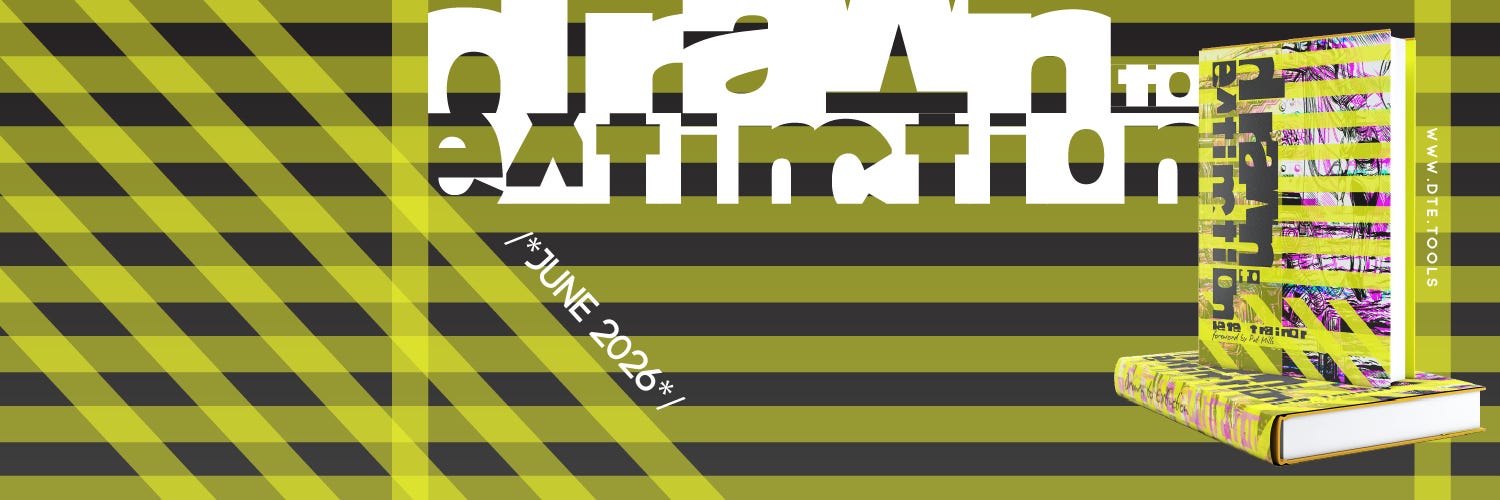
Pete is the author of Drawn to Extinction (2026), examining Ai’s impact on the comics industry. Available from independent booksellers and wherever comics matter in June 2026.